A VERY WARM WELCOME VISITORS
Showing posts with label Azaad. Show all posts

Sunday, November 21, 2010

HOW COMEDY CAME KNOCKING AT THE DOOR OF TRAGEDY KING, DILIP KUMAR: Part 2 of 2.


HOW DILIP KUMAR LANDED THE ROLE IN PAKSHIRAJA'S “AZAAD” (1956).


By the time “Azaad” was in the offing, Dilip Kumar had become the undisputed icon of the Indian screen but also earned the epithet of “Tragedy King”.  These roles, however, took a toll on the psyche of Dilip Kumar to such an extent that he had no option but to visit a psychiatrist for counsel and treatment. When Guru Dutt's Pyaasa (1957) was offered to him, Dilip Kumar did not want it  since he felt that that the character of Vijay in Pyaasa was an extension of  Devdas, and a bit too morose.  Doctors had advised him to take up lighter or comic roles in future so that the tragic aspects of his reel life did not overshadow his personality in real life. Thus the clouds of freedom from tragic roles began looming over him quite fortuitously.


The curtain of our drama unfolds way back in 1945 when SM Sriramulu Naidu (1910-1976) started Pakshiraja Studios at Pullakulam. A decade later, Pakshiraj Studios produced multi-lingual movies, cutting across the language divides and geographical boundaries. The Studios produced Malai Kallan (1954) in Tamil, featuring M.G. Ramchandran and Banumathi; Aggi Ramudu (1955) in Telugu with N T Rama Rao and Banumathi; Bettada Kalla (1957) in Kannada; Taskaraveeran (1957) in Malayalam; Soorasena (1957) in Sinhala; and the hindi movie Azaad (1956) that had Dilip Kumar and Meena Kumari. It is said that Mr. Naidu’s six-films phenomenon has not been repeated by anyone in the world.


How “Azaad” was finalized with Dilip Kumar is known comparatively to a very few persons in the Hindi film circle but the facts are gathered from the word of mouth of a person who was a witness to the entire meeting. It appears that Mr. Naidu happened to meet a personal friend of Dilip Kumar and told him that he intended to make comedy movie with Dilip Kumar. At the first blush, the proposition indeed appeared as a strange one: A South Indian Producer wanting to cast the Tragedy King of Bollywood as the hero of an adventurous comedy movie! However, it was not the first time that Mr. Naidu had had a brush with Hindi films. Earlier, he had dubbed the Madhubala-Premnath starrer Badal (1951) in Tamil (Puratchiveeran) and Malyalam (Desabhaktan) films. He requested him to let Dilip Kumar know about his plans. He requested that Dilip Kumar should meet him in his studio’s office. Mr. Naidu made it known that over and above his fees, all the sundry expenses including the to and fro airfare plus the hotel charges would be borne by him happily throughout the making of Azaad.  Dilip Kumar was not the one who could be swayed by just a lucrative offer. As he had once said, “Dilip Kumar is a precious commodity.” It has always been his principle throughout the life that he took up roles that he believed in and which would give him professional satisfaction.


For some reasons or the other nothing seemed to happen for some time. Mr. Naidu persistently pursued the common friend to persuade Dilip Kumar who, by this time, had already received a warning from his shrink that he should take a break from the tragic roles and venture into lighter roles. Now here was Mr. Naidu’s offer, a comedy role, that had come knocking at his door. So finally, Dilip Kumar relented and met him. He had a long list of conditions and demands. Mr. Naidu was a genius film-maker and go-getter who had done a thorough homework. As soon as Dilip Kumar would put a condition, Mr. Naidu would immediately agree to it one after the other. He left no scope for any disagreements. Mr. Naidu even agreed to willingly pay him a much higher fees than what Dilip Kumar usually charged for a movie. Even the signing amount and the contract were kept ready. Mr. Naidu had just one condition: and this was the time-frame within which the movie was to be completed. Since all his demands were accepted by Mr. Naidu, how could Dilip Kumar refuse the offer! The contract was signed on the spot.  Mr. Naidu took Dilip Kumar around many bungalows since there was not a single star-hotel in Coimbatore then. He also offered him the many rooms in his own  Pakshiraja Studio. The legend chose to sojourn in the studio. Meena Kumari followed suit. Azaad, the first Hindi movie in the region was shot in just three months in three schedules lasting 20 days each. Thus Dilip Kumar landed his first comedy role with a bang.


Azaad was a huge success and broke all box-office records. It was a breakaway movie for the Tragedy King Dilip Kumar where he played various roles of Kumar, Abdul Rahim Khan and that of the adventurous Robin-Hood of a Azaad where he sings KITNA HASEEN HAI MAUSAM to his lady love Shobha (Meena Kumari) in the wilderness after saving her from the kidnapper  Chander (Pran). The respectable but fun-filled role of Khan Sahaab who keeps a tab on the police and uses the information to his advantage and the way he as the bearded Khan Sahaab professes his love to the incredulous and shocked Shobha is a treat to watch. Hunting with the hounds and running with the hares seems to be the subtle underlying motif of this comedy called Azaad. Dilip Kumar’s costumes and his fighting sequences are a natural delight. Just observe how he rapidly swings his boxing fists at the villain, Pran. I daresay that such a professional style I have hardly seen in any movie unless it happens to portray the character of a martial artists. How Azaad triumphs over evil and how he as Khan Sahaab causes many a confusion to the characters around him are the stuff of comedies in this movie. The cine public were not used to see Dilip Kumar in such a role and therefore the movie made great waves at that time.   In 1957 he won the Filmfare Award in the Best Actor’s  category for his role again after Devdas. 

In passing, C.R. Ramchandra had given a melodious music and all the songs were great hits. I remember how a classmate of mine, named Mukta Jaitley, sang RADHA NAA BOLE NA BOLE RE in the inter-class competition and won the award as the best female singer in the school. JAA RI JAA RI O KAARI BADARIYA and DEKHO JI BAHAAR AAYI are other foot-tapping numbers. As for the qawwali, MARNA BHI MOHABBAT MEIN KISI KAAM NAA AAYAA is especially watchable for the tantrums of the Khan Sahaab. As for the song, APLAM CHAPLAM, which is a Lata-Usha duet, there is an interesting anecdote about how the lyrics of APLAM CHAPLAM came to be written. It seems that the lyricist, Rajinder Krishan was at his wit’s end hunting for words to suit the tune of that song. Pressed for time, C. Ramchandra was growing impatient with him as days passed by. One day, Rajinder Krishan left his home for the recording studio when his young daughter who could hardly speak told him to bring her “apam chapam”. She meant that she wanted Chappals or slippers. At once those words struck Rajinder Krishan as heaven-sent. He got what he had been seeking for days on end. Excitedly he went to C. Ramchandra and narrated the lyrics: APLAM CHAPLAM CHAPLAYI RE DUNIYA KO CHHO.D TEREE GALEE AAYEE RE AAYEE RE AAYEE RE.... The music director was pleased as a punch. The picturisation of the song was equally brilliant. The scintillating dance performance by the Sisters Subbulaxmi and Sai against that song is still fresh in the minds of cinegoers who went wild as soon as the song hit the screen. In her live performance, Lata Mangeshkar alway made it a point to sing that number to please her “elder brother” Dilip Kumar who graced such occasions. Even a couple of months back, while judging a certain dance competition, Jeetendra made it known to the competitors about those magical steps involved in the ‘aplam chaplam’ song. He, too, still remembers! A mention may also be made that the movie was first offered to Naushad for music compositions.  However, the conditions of haste were not acceptable to Naushad and he declined the offer.  It was then that C. Ramchandra was roped in since he was ready to churn out the numbers well in time but at the cost that the producers had first offered to Naushad. 

 Years later,  in an interview, Meena Kumari recalled how when shooting for the movie AZAAD Dilip Kumar had rescued her and himself from the jaws of death.  That happened during the scene where Dilip Kumar after saving her from the clutches of Pran's henchmen and kidnappers, tries to reach her home.  He takes her by a rope-trolley which navigates from one side of a mountain to the other at the height of some 300 to 400 feet above the valley.  Both she and Dilip Kumar sat in one trolley while in another trolley sat the Director and the Cameraman to capture the scene.  When her trolley reached midway, she felt a jerk as the rope began to give way because of the load of two trolleys carrying four people.  Sensing that the rope would break any time, Meena Kumari got panicky and she created lots of commotions.  However, Dilip Kumar’s calmness and solace gave her strength to remain calm and composed.  Finally, they reached the other end and were thus out of danger.   Meena Kumari could not forget that Dilip Kumar’s sheer presence of mind and calmness during such a disastrous situation had saved the day for them all!  
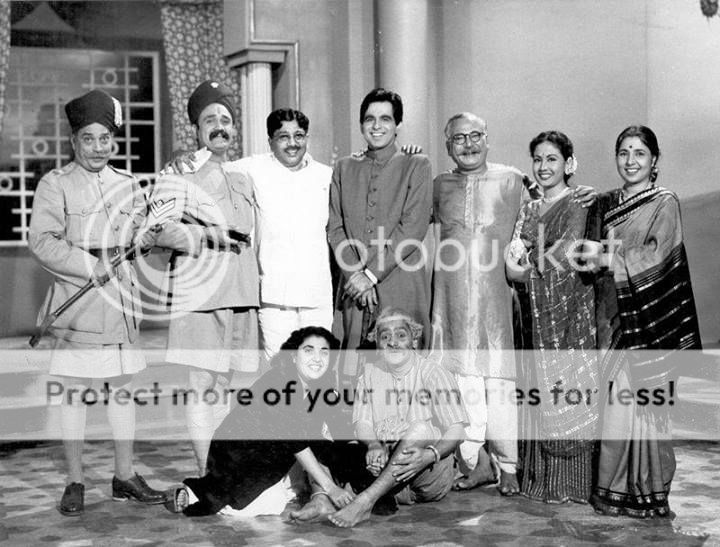

As a kid, I happened to watch Azaad in 1956 at Bombay’s Minerva Cinema where it was premiered. I remember that Azaad ran to full houses for all the shows (3 p.m., 6 p.m. and 9 p.m.) for some 38 weeks at the Minerva Cinema and left an indelible mark in the annals of the golden era of Hindi Cinema as the first comedy attempt and a successful one at that, by the Tragedy King, Dilip Kumar.


NASIR

HOW COMEDY CAME KNOCKING AT THE DOOR OF TRAGEDY KING DILIP KUMAR! Part 1of 2.

Dilip Kumar has been the “perfectionist” actor of the golden era of Hindi cinema, just as Amir Khan is addressed as Mr. Perfectionist in the current era of Bollywood. Another common appellation that is attached to his name is that of “Tragedy King.” We all know that by some quirk of fate, the initial career of Thespian Dilip Kumar took him through the portals of the many tragic roles in such movies as Jugnu (1947), Shaheed, Nadiya ke Paar, Mela (all 1948), Andaz (1949), Babul (1950), Deedar (1951) and Uran Khatola (1955) - to name just a few. While most of the roles ended in the death of the protagonist, some stories portrayed the hero as the living dead, as in Uran Khatola where his beloved is sacrificed to appease the tooth and claws of nature. Dilip Kumar’s transition to comedy happened only after Devdas (1955) that was yet another tragedy role that crowned Dilip Kumar as the King of Tragedy. It is for this reason that a small discussion about Devdas becomes imperative.


Speaking about Devdas, it was sometimes in mid- Nineteen Fifties that the ace director, Bimal Roy, cast Dilip Kumar in one of the most challenging roles ever. Dilip Kumar picked up the gauntlet to play Devdas - a character in Sarat Chandra, famous novel of that name. Of course, earlier in 1935, K.L. Saigal had donned the garb of Devdas. However, that Devdas is remembered more for the immortal songs of Saigal Saab. With the consummate artistry, Dilip Kumar was able to lend such intensity and realism to the role of the alcoholic and self-defeating Devdas that the character became larger than life and is  remembered even after 55 years of the film’s release.  Dilip Kumar’s acting prowess fetched him yet another Filmfare Award in the Best Actor category. Also, no Bollywood actor dared to enact a full-fledged role of Devdas, though down the years that was done in snatches or as a parody or even symbolically. Thus the critics have noted that the role of Sikandar, played by Amitabh Bachchan in Muqaddar ka Sikandar during his mega-star days, has the shades of a Devdas what with his wooing of  the courtesan  (Rekha) at her ‘Kotha’. Dharmendra too had dropped the idea of enacting the role of Devdas.


For Bimal Roy, Devdas was the labour of love and it rightly won him critics’ acclaims and the movie has passed on to the Hall of Fame as a Bollywood “Classic”. The flip side was that Devdas did not earn money for Bimal Roy who was therefore drained financially. The silver linining to that dark cloud, however, was that Bimal Roy toyed with the idea of making Madhumati, a heroine-oriented romantic story of rebirth, with Dilip Kumar and Vyajayantimala in the lead. When Madhumati was released in 1958 not only was Bimal Roy laughing his way to the Bank, but had even accumulated as many as nine Filmfare Awards – a record that was surpassed only in 1995  by  Dilwaale Dulhaniya Le Jaayenge.


When I had watched Devdas at the Bombay’s Swastik Cinema in 1955, I was just a kid who had no sense of the seriousness of the movie or about its huge star-cast:  Dilip Kumar, Suchitra Sen (Paro his childhood love) , Vyajayantimala (Chandramukhi the courtesan)  and Motilal (Chunni Babu who leads him to the 'Kotha'though reluctantly) .   I did not understand that the rigidity of the caste-system creates a great chasm between the hearts of men.   Nor could I then understand how  a failed childhood love should drive someone  so crazy that he would drink himself to death!  Why should a ravishing courtesan who is the cynosure of all eyes (though lusting eyes) give up her smiles and laughter plus a lucrative business for a man whose heart and soul belongs to some other woman who has been married off to a much older man whose children belong to the same age-group as Devdas.   Was that some vicarious love of Paro with which she hoped to win over the hopeless alcoholic?  His mere presence had changed everything not only from the outside but also from the inside of Chandramukhi.  He was the first man in her life who had given her a wad of hard currency without demanding anything from her in return.  Who was more praiseworthy?  Chandramukhi?  Or Paro,  who is crushed under the wheels of filial obedience but who nevertheless musters enough courage to sneak after mid-night to meet Devdas, a 'Mard' to speak about the marriage  only to be turned down by him since he lacks the courage to rebel against his parents and escapes to Calcutta.   Both Paro and Chandramukhi are ready to serve Devdas in their own way;  but Devdas has a promise to keep.  A promise to  visit Paro sometimes.  He does that.  He dies at her doorstep! 

Youngsters would hardly find anything of interest there that would be suitable to their age.  However, I had to revise my opinion when many years ago I read an article by an eminent female film journalist (since deceased).  She recounts that as a teenager how she and other girls used to bunk their school off and on to watch Dilip Kumar as Devdas at the Swastik Cinema. Since they had no money to purchase tickets for the movie, they used to move inside the movie-hall on the sly, only after the movie started. A “friendly” usher readily helped them find vacant seats in the dark hall  but at a price. While guiding them to the seats in the dark, he would fondle the girls at the wrong places. The girls did not mind as long as they could watch Dilip Kumar on the screen!  It is not surprising therefore that girls of impressionable age too fell for his on-screen charm. Unknown to him, his future wife, Saira Banu, had a crush on him since she was twelve!     Evidently, Dilip Kumar’s persona was not less of a lady-killer even in such a  movie as Devdas where he dons a sombre, drunken  and brooding  look  almost all the time. 


More than four decades wouId pass before someone could think of re-making Devdas in earnest. Sanjay Leela Bansali decided to re-make Devdas with Shahrukh Khan in the title role. Though Sanjay Leela Bhansali’s Devdas was a box-office hit, it wasn’t a faithful adaptation of the novel. Nor did it have a stark realism of the older black- and-white version.  Compared to the rustic version, the new Devdas was a glamourised version which looked more of a costume drama that had lavish sets and was packaged in gaudy colours, artificial histrionics, and contrived sub-plots, such as the non-existent meeting of Chandramukhi (Madhuri Dixit) with Paro (a younger Aishwarya Rai) and and their mega song-and-dance sequence. The liberties taken by Sanjay with the original novel rightly had the purists fuming.


As for Shahrukh Khan, he had the explicit blessings of  Dilip Kumar and Saira Banu. In fact, it was Saira Banu who stated that if anyone could do Devdas it would be Shahrukh Khan. Shahrukh Khan must have certainly found it tough to do justice to the role for it is said that he often took to drinking on the sets to bring realism to his role of the drunkard.  According to Shahrukh, "My Devdas is just a tribute to Dilip saab 's performance. I hope that a lot of youngsters would watch me and then go back to watch Dilip saab as Devdas."   That was sweet of him to say!   However, while comparing the roles of Dilip Kumar and Shahrukh Khan, Vyajayantimala stated that Dilip Kumar had acted as Devdas while Shahrukh Khan acted as himself.

Reference to Devdas was a must, since the character had taken a toll of the psyche of Dilip Kumar and it was imperative that his humours were restored.  It was at this moment that Azaad, a non-tragedy film,  appeared to be God-sent. 


To continue...

NASIR