
From the Layman’s Desk – 14: continued...
![]()
IN THE NAME OF ALLAH, MOST BENEFICIENT, MOST MERCIFUL.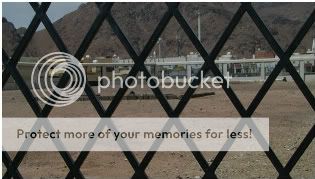
Visiting the Graves of the Martyrs of Islam:
As every Muslim knows, Uhud is the place where the martyrs, including Hadhrat Hamza ®, are buried. Islamic scholars have generally given the number of martyrs as 70. [Even so, Imām al-Barzanjī has the names of 103 Companions whom he considers to have been martyred, Shaykh Mustafā Rushdī ad-Dimashqī and al-Hājj Muhammad bin Nāsir al-Qādirī ash-Shāfi‘ī have 101 and Shaykh ‘Abdur Rahmān Chohravi has 86. One reason why the list is greater than 70 is that in some instances, Muslim historians and the ‘ulamā (the learned) are not absolutely sure from the evidence they have collected whether a particular Companion was actually martyred at Uhud or not. So, perhaps they have decided to err in including the name rather to err in leaving it out.]
The Messenger of Allâh [sal Allahu alayhi wassallam] supervised the martyrs’ burial and said: "I bear witness that anyone who is wounded in the way of Allâh, Allâh will resurrect him with his wound bleeding a liquid which is blood-like in colour but musk-like in scent." [Ibn Hisham 2/98]
Every year the Prophet (sal Allahu alayhi wassallam) would visit the graves of the martyrs {shuhada'} of the Battle of Uhud and recite this prayer: “Peace be on you because you were constant, how excellent, is then, the issue of the abode.” During his visit to the martyrs, especially in the ziyarah to Hamzah ibn Abdul Mutallib al-Badri al-Muhajiri ® and Mus'ab ibn 'Umayr al-Badri al-Muhajiri ®, the Holy Prophet (s) would recite this verse, “Men who fulfill what they have pledged to Allah.”(Qur’an: Surat al-Ahzab 33:23).
It is mentioned in the Holy Qur’an:
1. "And say not of those who are slain in the Way of Allah 'They are dead'. Nay, they are living, though you perceive it not" (Quran: 2:154).
2. “Think not of those who are slain in Allah’s way as dead. Nay, they are living, finding their sustenance from their Lord.” (Quran:3:169).
The Holy Prophet (sal Allahu alayhi wassallam) said: “When your brethren were martyred at Uhud, Allah placed their souls inside green birds which drink from the rivers of Paradise, eat of its fruits and seek shelter in gold-lamps that are suspended in the shade of the ‘Arsh’ (Throne). When they saw how beautiful their food, drink and the abode was, they pleaded, ‘Who will tell our brothers about us, that we are alive in Paradise and being amply provided for, so that they will not turn away from Jihad or abandon the battlefields. Allah ta’la said: ‘I shall tell them!’ The verse was then sent down: “Think not of those slain in Allah’s way as dead. Nay, they live, finding their sustenance from their Lord. They rejoice in the bounty provided by Allah” (3:169-170).
The martyrs in the cause of Truth are not dead. They are alive in a much beautiful and joyous life than that on this material earth. The rank unique to the martyrs is that their soul will be able to roam about in Paradise and enjoy its fruits even before the Resurrection and Judgment Day. Abdullah ibn Masood reports that the Holy Prophet (sallallaahu alaihi wa sallam) said: Their souls are within green birds, having lanterns suspended from the Throne, roaming freely in Paradise as they please, then taking shelter in those lanterns. ( Reported by Muslim). The second Caliph of Islam, Hadrat Umar ®, agreed that the souls of the martyrs are in Paradise, and yet they are greeted at their graves in the manner the other people who have passed away are greeted.
Imam Baihaqi too narrates that Messenger of Allah [sal Allahu alayhi wasallam] used to visit the graveyard of the martyrs of Uhud annually. Imam Fakhruddin al-Razi writes in Tafseer-e-Kabeer that on such occasions all the Four Foremost Companions used to do the same. Ibrahim bin Muhammad (R) reported that Holy Prophet used to visit the graves of martyrs of Uhud Battle in the beginning of year and said : “Salaam on you ! As a result of your patience, what a nice place you got in the Hereafter!” Abu Bakr ®, Umar ® and Uthman ® also used to visit in the same way.
[ref :- 1.. Abdur Razzaq al-musnaf : 3:573 2.. Aini , Umdat-ul-Qari, 8:70 3.. Tabari, Jami Al-Quran, 13:142 4.. Imam Suyuti, Dur-ul-Mansoor, 4:641 5.. Ibn-e-Kathir, tafseer-ul-Quran-ul-Azeem. ] Radd al-Muhtar (also famous as Hashiyat Ibn Abidin and, in the Indian subcontinent, as Shami) also contains a prophetic tradition in Vol. 1, Baabu Ziyaaratil-Quboor to show that the Holy Prophet [sal Allahu alayhi wasallam] used to visit Uhud annually.]
When the Holy Prophet [sal Allahu alayhi wasallam] used to visit the martyrs ® in Uhud every year, he would greet the martyrs by standing at a place called Hurrat al-Waqum. He greeted each one separately when he visited them in the eighth year of the Hegira and said "They are martyrs. They know who visits them. They hear when they are greeted and they reply.”
'Abd al-Haqq ad-Dahlawi (Reh) one of the great 'ulama' of India (d.1052 A.H./1642 c.e.), while narrating the Battle of Uhud in his Persian book Madarij an-Nubuwwa, quotes Abu Farda ® as saying, "One day Rasulullah visited the martyrs in Uhud. After saying, 'Oh my Rabb who is worthy of being worshiped! I, Thy servant and Messenger, testify that these got martyred to gain Thy Consent,' he turned to us and said, 'If someone visits and greets these martyrs, they will answer him. They will answer the same way till the Last Day.'"
Additionally, in As-sahih it is recorded that Abu Sa‘id al-Khudri would extend salutations to the grave of Hamzah (R). Umm Salamah, one of the honorable wives of the Prophet [sal Allahu alayhi wasallam], and individuals such as Abu Hurayrah, Fatimah Khuza‘iyyah, and ‘Abd Allah ibn ‘Umar al-Khattab (may Allah be pleased with them) also used to perform ziyarah to this group of martyrs.
As narrated in a hadith in Abu Dawud, Rabi'ah ibn al-Hudayr said: I did not hear Talhah ibn Ubaydullah narrating any tradition from the Apostle of Allah (s) except one tradition. I (Rabi'ah ibn Abu Abdur Rahman) asked: "What is that?" He said: "We went out along with the Apostle of Allah (s) who was going to visit the graves of the martyrs. When we ascended Harrah Waqim, and then descended from it, we found there some graves at the turning of the valley. We asked: 'Apostle of Allah, are these the graves of our brethren?' He replied: 'Graves of our companions.' When we came to the graves of martyrs, he said: 'These are the graves of our brethren.'" [Sunan Abu Dawud: 10: 2038.] (It may be recalled that Talhah ® had fought valiantly at Uhud and earned the title of “The Living Martyr”.)
It is clear from the above, that not only did the Prophet (sal Allahu alayhi wassallam) visit graves of his Companions and the Shuhda', he made a special effort to do so and was accompanied by his Companions.
It is mentioned in Mirat al-Madina that Fatimat al-Khuzaziyya (reh.) said, "I was passing by the Uhud field. I said, 'Oh Hamza ® Rasulullah's uncle, salam be on you!' Then I heard the answer, 'May Allah's salam, mercy and blessings be upon you!” Utaf ibn Khalid al-Mahzuni said that his aunt greeted the martyrs in Uhud and that they replied to her, "We know you!"
Hafidh Ibn Kathir writes: that Ata Bin Khalid stated: My Aunt went to the grave of Hamza (May Allah be well pleased with him) and said, “Asslam u alaikum!” She heard the answer of the Salam and the voice was coming from under the earth. She said, “I recognised the answer of my Salaam, as I recognise that Allah most High has created me. As I recognise the differences between day and night, that is how clear it was. Besides my slave and I there was no other person, which is why I was frightened.” [Sirat un-Nabi chapter War Uhad by Hafidh Ibn Kathir]
Al-Haakim has reported on the authority of Hadrat ‘Ali ® that Fatima ® used to visit the grave of her uncle Hamza ® every week. There she would perform Salaat, pray and weep. It is reported on the authority of Imam Muhammad al-Baaqir that Fatima ® used to visit the graves of the martyrs every two or three days until she died. Imam Ja’far as-saadiq narrated with his chain from al-Hasan ibn ‘Ali ® that Fatima ® used to visit the grave of her uncle Hamza ibn ‘Abd al-Muttalib every Juma’. The second version which is reported by al-Haakim as “Sound” says that she used to weep and pray there; the third version says that she had marked the grave to recognize it. The third version is mentioned by al-Qurtubi in his Tafseer and this was narrated by al-Athram and ibn ‘Abd al-Barr. It is mentioned in Mir’at al-Madina (1301 A.H.) that Fatima az-zahra ® used to visit Hadrat Hamza’s grave at Uhud every two days and would put a mark so that the grave should not be forgotten. She would go there every Thursday night (i.e. the night before Friday) to perform Salaat of many Raka’ and would weep much.
"Hadhrat Sa’ad Bin Abi Waqas used to visit the martyrs of Uhud with his companions and asked them to send salam upon the martyrs who answer your salam." (Sharhus Sudoor - Page 193, Jazbul Quloob - Page 202)
Imam Baihaki (reh.) quoted Abdullah ibn Umar ® as saying: “My father Hadhrat Umar and I visited the martyrs on a Friday before sunrise. My father greeted all of them. We heard their reply. My father asked me, ‘Did you answer me?’ I said, ‘No, the martyrs did! He took me on his right and said salaam to each of them separately. We heard each of them reply three times. My father immediately prostrated and thanked Allah ta’ala.” Now, hearing the reply three times is also significant because in the same grave there were three martyrs buried: Hadhrat Hamza ® his nephew Abdullah bin Jahsh ® and Mus’ab ibn ‘Umair ®. The remaining martyrs were buried together by two’s and three’s in one grave, and a few in the Baqi cemetery.
As regards the historic Khutba at Uhud and its significance, by the Holy Prophet (sal Allahu ‘alayhi wassallam) during the last year of his blessed life at Madina Munawwara,
Uqba ibn Amir reports that the Prophet (peace and blessings of Allah be upon him) left one day and prayed for the martyrs of Uhud. Then he returned to the Minbar and said:
‘I am preceding you. And I am a witness (Shaheed) over you all. I swear by Allah! I am verily looking at the Hawdh Kauthar now. And verily, I have been given the keys to the treasures of the earth, or the keys to the earth. And verily, I swear by Allah! I do not fear that you will commit Shirk after me. But I do fear you will compete and fight with one another.’
(Sahih al-Bukhari; Book of Funerals; Chapter; Prayer on a Martyr).
We shall discuss the significance of the above Khutba appropriately at a later stage of our topic.
In the meanwhile, let us see some examples of the living proof as to how the martyrs are alive in their grave:
Narrated Jabir ®: When the time of the Battle of Uhud approached, my father called me at night and said, “I think that I will be the first amongst the companions of the Prophet (sal Allahu alayhi wassallam) to be martyred. I do not leave anyone after me dearer to me than you, except Allah’s Apostle’s (sal Allahu alayhi wassallam) soul and I owe some debt and you should repay it and treat your sisters favorably (nicely and politely).” So in the morning he was the first to be martyred and was buried along with another (martyr). I did not like to leave him with the other (martyr) so I took him out of the Grave after six (6) months of his burial and he was in the same condition as he was on the day of burial, except a slight change near his ear. (Bukhari Book #23, Hadith #434).
Yahya ® related to me from Malik from Abd ar-Rahman ibn Abi Sasaca that he had heard that Amr Ibn al-Jamuh al-Ansari ® and Abdullah Ibn Umar al-Ansari ®, both of the tribe of Banu Salami, had their Grave uncovered by a flood. Their Grave was part of what was left after the flood. They were in the same Grave, and they were among those martyred at Uhud. They were dug up so that they might be moved. They were found unchanged. It was as if they had died only the day before. One of them had been wounded, and he had put his hand over his wound and had been buried like that. His hand was pulled away from his wound and released, and it returned to where it had been. It was forty-six (46) years between Uhud and the day they were dug up. Malik (reh) said, “There is no harm in burying two or three men in the same Grave due to necessity. The oldest one is put next to the qibla.” (Malik’s Muwatta – Book #21, Hadith #21.20.50).
When the bodies of the martyrs of Uhud were being relocated forty (40) years after their burial, the foot of Hamzah bin 'Abd al-Mutalli b ® was scratched in the process of being moved, and it started gushing blood. ['al-Bidayah wan-Nihayah'; 4/43]
The above incident is also evident from a hadith shareef in Sahih Muslim where it was mentioned that Muslim historians had reported, when Mu’awiyah ruled, he was planning for a water channel to be built in Madinah. In order for this development to be achieved, the channel had to be routed through the middle of the Madinah cemetery. Therefore, he ordered the remains of the dead in the graves to be transferred to another place. In the midst of the dismantling and relocation process, the people found that the corpses were still in their original states. When one of the shovels they used accidentally hit and slashed the leg of Hamzah bin Abdul Mutalib, blood was seen flowing from the cut. Whereas, that occurrence had already surpassed the Battle of Uhud by fifty (50) years.
In his series (Story of the End) Dr. Tariq Suwaidan mentioned that Sheikh Muhammad As-Sawwaf, one of the scholars who were chosen to rebury the martyrs of Uhud after the flood that uncovered the bodies, told him that their bodies did not change, decompose, or rot even after Fourteen Hundred (1400) years from their death. Sheikh Muhammad As-Sawwaf said that: “Among the bodies was that of Hamza (may Allah be pleased with him). He was big and his nose and ears were cut. His abdomen was ripped apart and he put his hand on it. When we took his hand up, blood flew down as if he died one hour ago.)(3)
Narrated ‘Urwa ® : When the wall fell on them (i.e. on Graves) during the Caliphate of Al-Walid bin ‘Abdul Malik, the people started repairing it, and a foot appeared to them. The people got scared and thought that it was the foot of the Prophet (sal Allahu alayhi wassallam). No one could be found who could tell them about it till I (‘Urwa – ® ) said to them, “By Allah, ( swt) this is not the foot of the Prophet (sal Allahu alayhi wassallam) but it is the foot of Umar ®.” (Bukhari Book #23, Hadith #474).
In the prophetic tradition reported in Sahih Muslim, Ja’far ibn Abi Talib ® after his martyrdom (in Battle of Mu'tah - 8H/629 c.e.), was seen among the angels and they were giving the glad tidings of the coming rains to the people of Beesha. According to another hadith, Ja’far ® came to the Holy Prophet [sal Allahu alayhi wasallam]along with an angel and he had two wings which were blood-stained, and they were going to the valley of Beesha in Yemen. Then there is a long hadith that the Holy Prophet [sal Allahu alayhi wasallam] informed Asma’ bint ‘Umais how her husband, Ja’far, came to him (s) with Jibrail and Mikail (a.s.) and explained how he attained martyrdom; that he had two wings, and that Ja’far ® told him that he flies in and out of Paradise whenever he wishes and he also eats the fruits of Paradise, and so on. Therefore, according to Imam Sayuti, the souls are permitted to attach to and dispose their bodies while they are at ‘Illiyin’ (the Seventh Heaven in which there are believers' souls). These ahadith also reveal that Allah Subhana Ta'la permits his martyrs and pious souls to do the useful deeds for people.
After the noon prayers, on 20th Zilhajj 1351 A.H. (1932 c.e.) a large number of Muslims and non-Muslims gathered in Baghdad to witness the transfer of the bodies of Jabir bin Abdulla Ansari ® (d.78 AH/697 c.e.) and Hudhaifa al-Yamani ® (d.36 AH/656 c.e.) to a safe place from their water-logged grave. The ruling king of Iraq Shah Faisal had been instructed by Hudhaifa al-Yamani in a dream. First when the grave of Hazrat Hudhaifa was opened water was found inside. The body was lifted with a crane in such a way that it safely came on a stretcher. Then the stretcher was lifted by the King, the Grand Mufti, the Prime Minister and Prince Farooq of Egypt and brought to a glass coffin box made especially to keep the holy bodies. The body of Hazrat Jabir was also transferred to the glass box in the same scrupulous manner. Both the holy bodies of these true companions of the Holy Prophet (sal Allahu alayhi wassallam) were fresh and intact while their open eyes issued forth such divine light that the spectator's eyes were dazzled. Furthermore, their coffin, clothes, kaffan were also intact and at first glance, it appeared as if these heroes of Islam were alive. The two bodies were then taken away and buried afresh near the grave of another great hero of Islam, Salman-e-Farsi, in Salman Park which is 30 miles from Baghdad. This miracle amazed the scientists, philosophers and doctors. They were all bewildered and spellbound to witness this great miracle.
Imam ibn Hajar al-Asqalani states in his monumental “Fath al-Bari” which is commentary on the Sahih Bukhari: "When the living of the martyrs is proven from the text of the Qur'an, then this is also proven from an analogical point of view. And the Prophets are superior to the martyrs." In the same commentary, Fath al-Bari, 17/22), Imam Ibn Hajr al-asqalani emphasized that "Death will never come to the Blessed Messenger of Allah [sal Allahu alayhi wasallam] in his grave, but he will remain alive, due to the fact that the Prophets remain alive in their graves". Which explains why, and it is a known fact, the bodies of Prophets, the Martyrs, the noble Sahabah and Awliya-Allah remain fresh and intact in their Graves. There is in fact an overwhelming evidence in this regard all of which pertains to another subject, namely, that Holy Prophet [sal Allahu alayhi wasallam] is alive in his grave – but this merits a dissertation by itself – and hence won’t be detailed in our topic.
Finally, visiting the grave of the Prophet [sal Allahu alayhi wasallam] falls under the general permission and recommendation to visit graves of the Companions and martyrs, which is Sunnah of the Prophet [sal Allahu alayhi wasallam]. Additionally, since in some cases the Holy Prophet (sallal laahu alaihi wasallam) would also make a habit of visiting them at specific times every year, e.g. at Uhud, this also establishes the Sunnah of Urs as we shall discuss later.
To continue Insha Allah:
Nasir


