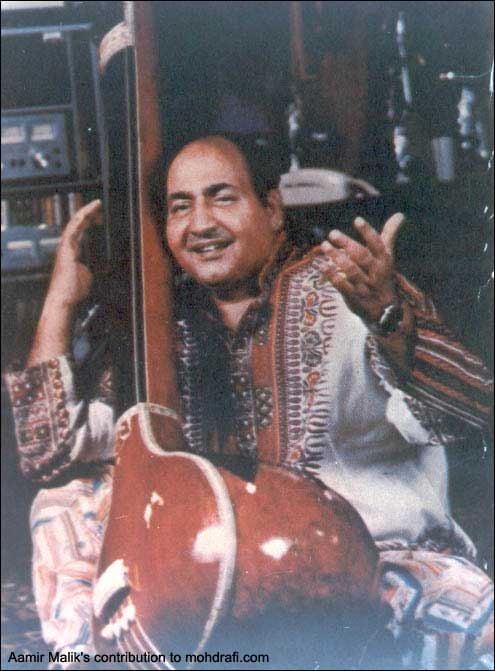
Even after 30 years of the sad demise of the Indian Singing Legend, Mohammed Rafi Sahaab, the world is still enchanted by his magical voice that poured thousands of songs of all genres. Apart from Hindi/Urdu, he sang in many regional languages including Marathi, Punjabi, Bengali, Bhojpuri, Konkani, Sindhi, Kannada, Telugu, Gujarati, Maghi, Mathili, as well as in English, Afghani and Creole languages. Along with his songs, one could laugh with him, weep with him, indulge in intense romance and innocent flirations, lament the loss of beloved and bewail the pangs of separation as well as reflect on the transitory nature of life and world and then find solace in the heart-wrenching and heart-rending appeal to the Divine Power for peace and serenity. Life becomes meaningful and less ardous when we listen to this mellifluous voice. There is indeed a therapy for the soul in Rafi Sahaab’s songs. We may listen and learn from him, but there can never be another Rafi, whether as a singer or a human being, in the world of music, entertainment and films.
NASIR
FRESH TRIBUTES TO RAFI SAHAAB ON 30TH DEATH ANNIVERSARY AT THE LAUNCH OF RAFI MUSIC ACADEMY IN MUMBAI.
During the launch of Mohammed Rafi Academy by Shahid Rafi and his wife, Firdaus Shahid Rafi, various film personalities came together to pay their tributes to the memory of the Great Singing Legend, Mohammed Rafi Sahaab. Music directors Pyarelal of the Laxmi-Pyare duo, Ravi, Kalyanji of the Kalyanji-Anandji duo, Bappi Lahiri and Ravinder Jain were present. Also present were singers Udit Narayan, Amit Kumar, Sudha Malhotra, Shabbir Kumar, Adnan Sami and Nitin Mukesh, as well as actors Sanjay Khan, Jackie Shroff, Dara Singh, Jagdeep, Javed Jafri, and Jeetendra. Producer/actor/director Rakesh Roshan too graced the occasion. Others included the “Binaca Geet Mala” legend, Amin Sayani, Diamond Merchant Bharat Shah, Lyricist Naqsh Lyallpuri, Hassan Kamaal, Rajit Sayani, Ashok Shekhar and others.
The objective of the Mohammed Rafi Academy is to foster music among young talents at a young age, especially those who come from the economically backward classes and cannot afford the fees of formal training. Hence, the Academy will be thick in charity works too. We are also told that the Academy will also honour the past and living legends by honouring the artists themselves and their families on birth and death anniversaries. The governing body of Rafi Academy is represented by Shahid Rafi, Raju Naushad (Naushad’s son), Andalib (son of Majrooh Sultanpuri), and Rohan Kapoor (son of Mahendra Kapoor).
The lamp-lighting ceremony was led by the heart-throb of yesteryear, Yahoo Shammi Kapoor. Rich tributes were paid to Rafi Sahaab by the veteran film-stars and composers:
Shahid Rafi: Aaj hamaare waalid sahaab kee teesvi.n barsee hai, aur hamne sochaa hai ke “Mohammed Rafi Academy” launch kare.n....Mujhe behad Khushee hai ke aap log yahaa.n aaye, mujhe aashirwaad diyaa ab is Academy ko aashirwaad dijiye ke yeh kaafee aage ba.Dhe. …. Jabhee Rafi Sahaab se koee boltaa thaah ke..matlab.. Waah Rafi Sahaab aapne kyaa gaayaa, toh bolte….aisaa ishaaraa karte theh (with the tongue between the teeth and nodding the head and pointing the finger to the sky, to show denial) …Matlab yeh thaah ke oopar waale kee dayn hai bas! …Mere me.n kuchh nahee.n hai, sirf oopar waale ne dayn diyaa hai mujhe, usee kaa istemaal kar rahaa hoo.n. (He sang his father's DIL KAA SOONA SAAZ TARAANAA DHOONDHEGAA).
Shammi Kapoor: Rafi Sahaab ke baare me.n bahot kuchh hai kehne ko. Mai.n nahee.n samajhtaa ke mere paas, aap ke paas itnaa waqt hai…. I can definitely say one thing that without Rafi Sahaab I was incomplete.
Rishi Kapoor: Aap ne sahee farmaayaa ke Kapoor parivaar kaa Rafi Sahaab ke saath ek lambaa sahyog rahaa hai. Jab ke Raj Kapoor Sahaab kee aawaaz Mukesh ji theeh, lekin Shammi uncle, Shashi uncle, kuchh gaane Daboo aur maine…, mere ‘career’ me.n Rafi Sahaab ka bahot ba.Daa haath rahaa hai. Manmohan Desai Sahaab kehte theh ke agar Khuda kee koee aawaaz hai toh voh Mohammed Rafi hai. .....I was lucky that Rafi sahaab has even sung for my films. One of my favorites from my film Hum Kisi Se Kum Nahi is called Kya Hua Tera Wada. It was one of the best romantic and sad songs of that time. Rafi sahib had a voice that suited all stars of all ages. (Indeed, who can forget the Laila Majnu numbers as well as PARDA HAI PARDA HAI and SHIRDI WAALE SAI.N BAABA from AAA? And that rapturous romance in: DARD-E-DIL from Karz.)
Jeetendra: You see, very few people can do what he did! In same movie he’s singing for Guru Dutt and you feel that Guru Dutt is singing. It doesn’t sound as if somebody is giving lip-synching, and he’s singing for Johny Walker also. See the contrast. Can you imagine the talent! But…. according to me, he must have… sang hundreds of songs where the producers must not have been able to pay money and he sang them free. (He reminded the audience that Rafi Sahaab had waived his singing fee after learning that Jeetendra’s costliest extravaganza, Deedar-e-Yaar, had flopped at the box-office.)
Pyaarelal (of L-P duo): Rafi Sahaab ka kyaa, un kaa alag… un kee izzat alag hai. Un kee aawaaz me.n ek bahot hee Khaaseeyat theeh, jo bahot kam logo.n me.n hotee hai. Ke bhai, un kee Khaaseeyat yeh hai ke koee bhee.. koee bhee ‘artist’ ho, koee bhee ‘hero’ ho, un kee aawaaz kahee.n bhee ‘suit’ ho jaatee theeh. Toh yeh jo Khaaseeyat hai bahot kam logo.n me.n hotee hai. Har ek ‘voice’ me.n nahee.n hotee. …. ayaak kee baat toh chho.Diye. Aise insaan naa huwe naa abhee hai.n, naa ho.nge. (Sings: CHAAHOONGA MAIN TUJHE SAANJH SAVERE/AAWAAZ MAIN NAA DOONGAA)
Jagdeep: Rafi Saab dil kaa maalik thaah. Dil se gaataa thaah, aatmaa se gaataa thaah. Dil se jo baat nikaltee hai, asar rakhtee hai, par nahee.n taaqaat-e-parwaaz magar rakhtee hai. Aaj tak hamm us aawaaz ko sun rahe hai.n, saraahanaa kar rahe hai.n, magar ro rahe hai.n. (We still remember the Rafi Sahaab's philosophical number: AADMI CHIRAAGH HAI that was filmed on the young Jagdeep in Barkha; CHALI CHALI RE PATANG MERI CHALI RE which was a Rafi-Lata duet in AVM'S Bhabhi; as well as PAAS BAITHO TABIYAT BEHEL JAAYEGI in Punar Milan which was a Jagdeep-Ameeta starrer).
Rakesh Roshan: Mujhe lagtaa hai yeh bahot ‘late’ khulaa hai, bahot pehle khulnaa chahiye thaah. ‘And it’s very good for the upcoming singers…’ (He also informed the audience that though Rafi Sahaab sang a few songs for him, the Legend had enormous work with his late father, Composers Roshan and brother Rajesh Roshan.)
Jackie Shroff: Kaisaa bhulaayegaa bhai sahaab. Jo mere se kaam karaayegaa karoo.ngaa. Rafi Sahaab ke liye jootaa paalish karaane kaa hai, karoo.ngaa. (With Shabbir Kumar he sings: ROKA KAI BAAR MAINE DIL KI UMANG KO/KYAA KAROON MAIN APNI NIGAAHON KI PASAND KO/O JAANE JAA.N.....and HAMNE TOH DIL KO AAP KE QADMON PE RAKH DIYAA/IS DIL KA KYAA KAREN KE YEH AB AAP SOCHIYE...)
Dara Singh: Bahot Khushee kee baat hai ke Rafi Sahaab ke naam Mohammed Rafi Academy bann rahee hai. Mai.n chaahoonga key yeh bahot bahot kaamyaab ho. Bachche jo kosheesh kar rahe hai.n bahot hee saraahiniye baat hai. (Don't we remember ZINDAGI ME.N AAYAA TOOFAAN?)
Bappi Lahiri: Bahot bahot mubaarak Shahid ko, aur mai.n sab kaam chho.D ke aaj kaa din ‘free’ rakkhaa. Toh, Rafi Sahaab ko mai.n itnaa ‘respect’ kartaa thaah. Aur Rafi Sahaab..ek ‘singer’ ke roop me.n nahee.n… ‘He was a gem of a person, gem of a human being, Toh meraa hisaab se Rafi Sahaab ka Academy pehle hee banana chahiye thaah. Lekin, ‘anyway’ jo Shahid ne kiyaa, bahot achchaa kiyaa. Mohammed Rafi Academy… Hamm log ‘foreign’ me.n jaate hai.n, Hollywood me.n kaafee ‘Stars’ kaa ‘Academy’ hotaa hai. Lekin Mohammed Rafi kaa ‘Academy” honaa hee chaahiye. One and only Rafi Sahaab Zindaabaad. ….Mai.n…..Rafi Sahaab ko mai.n bas ‘singer’ nahee.n bolnaa chaahtaa hoo.n. Voh aise insaan theh. Mai.n aaj kal har naujawaan ko boloonga aisaa insaan bano – Rafi Sahaab jaisaa… One and Only. (He sings PHOOL KA SHABAAB KYAA/HUSN KA MAHTAAB KYAA/AAP TOH BAS AAP HAIN/AAP KAA JAWAAB KYAA....)
Amin Sayani: ….Lekin…haa.nh. Lata ne mujhe bataayaa ke ek baar Rafi Sahaab aur un kee kuchh..tho.Dee an-ban ho gayee theeh. Baat chhoTee si theeh, ‘Royalty’ kaa maamlaa thaah. Ab Royalty’ ke baare me.n Rafi Sahaab keh rahe theh ke hamm toh paisaa lete hee hai.n hamm ‘Royalty’ kyoo.n le.n? Lata ne kahaa bahot saare aise ‘singers’ hai.n jo kehte hai.n ‘Royalty’ milnee chaahiye. Toh is par tho.Daa saa … jhag.Daa nahee.n huwaa, khee.nchaa-taanee ho gayee. Lekin Lata ne yeh bhee kahaa ke saab, Rafi jaise aadmee bahot kam theh duniya me.n, koee un me.n buraaee nahee.n. Hameshaa pyaar se kaam karte theh, hameshaa ba.De, ba.De….Bahot saleeke se, ba.De adab se kaam karte theh, aur, aur sabke saath miThaas ke saath bartaav karte theh.
Adnan Sami: …Baat yeh hai ke, Rafi Sahaab ne contribution jo music me.n, duniya me.n, kee hai, voh bemisaal hai. (Sings Yeh duniya yeh mehfil)
Javed Jaafri: Laakho.n log inspire huwe Rafi Sahaab se. Aur agar voh inspiration institutionalize kiyaa jaaye I think it is a very good concept. Aur sahi haath me.n hai….
Ravindra Jain: Rafi Sahaab ne apna naam Mohammed se sajaayaa hai, Mohammed naam aisaa hai jo doh jahaa.n(?) pe chhaayaa hai, Rafi Sahaab ke pardaa kar lene ke baad, aaj kal yaaro.n, naa waisaa gaayak aayaa hai, naa waisaa insaan aayaa hai. (He sings: Gham bhee hain naa mukammal, Khushiyaan bhee hain adhooree, aansso bhee aa rahe hain, Hansnaa bhee hai zarooree....)
Udit Narayan: Mai.n actually ba.Daa emotional ho gayaa hoo.n. Rafi sahaab jaisa kalakaar, Rafi Sahaab jaisa insaan ho hee nahee.n sakta hai. (He's one of those blessed newcomers who shared the same mic with Rafi Sahaab at the start of their careers).
Nitin Mukesh: (Reminiscing over what his father, the celebrated and late Playback Singer Mukesh, said:) Sun, main hoon main apne gaane gaaoongaa. Magar tuu Rafi ke gaane gaa. Aur bhagwaan jaantaa hai,main... mujhe...mann me.n kabhee irshaa bhee hotee theeh ke papa kyoon kehte theh, Gaanaa seekhnaa hai...gaane waalaa bannaa hai...achchaa gulukaar bannaa hai, Mohammed Rafi ke gaane gaao. Papa Theek kehte theh!
NASIR
This Blog is a humble Tribute to the Legendary Indian Playback Singer, Mohammed Rafi (1924-1980) whose songs continue to attract the older and the newer generations day by day. This Blog transliterates and translates his Solo Songs into English for wider appreciation. The Blog will also publish posts on his life and times, and other topics.
A VERY WARM WELCOME VISITORS
Showing posts with label Tribute to Rafi. Show all posts
Saturday, August 7, 2010
Sunday, October 11, 2009
PART 15: MOHAMMED RAFI & THE NINETEEN FORTIES.

Concluding Part of the Tribute to the Greatest Playback Singer of All Times – by Nasir:
Here on the Bollywood music scene in the Forties, Mohammed Rafi surmounted all competitions and emerged as a winner. According to statisticians, when the Forties ended, Rafi Sahaab had sung more songs than the combined songs of all the male playback singers, including Mukesh, Talat Mehmood, Hemant Kumar, Manna Dey, C.Ramchandra and Kishore Kumar. Similarly, by the end of the decade Zohrabai would top the chart for the most popular female singer, recording three times more songs than either Lata Mangeshkar or Geeta Roy. Asha Bhonsle was nowhere in the reckoning.

In the Fifties, it would be a tough going for Mohammed Rafi what with Mukesh competing for the sad songs plus mainly the Raj Kapoor songs, Talat Mehmood competing mainly for ghazals and nazams and romantic songs plus Dilip Kumar songs, Manna Dey competing mainly for classically-based songs, patriotic songs and the Bhajans, with C. Ramchandra also trying to fill in the gaps wherever he could, Hemant Kumar competing for Pradeep Kumar songs, and coming out with beautiful romantic solos and duets and ‘loris’ (lullabies), Kishore Kumar competing for comedy songs plus mainly Dev Anand's songs and the compositions of S.D. Burman. Happily, Naushad would revise his preferences for one reasons or another in the Fifties and stand by Mohammed Rafi like a solid rock. But that alone would not do. Rafi Sahaab had to work his way around all the music directors if he were to survive. This he did very deftly by keeping himself abreast of the times by always being a learner and cultivating good habits such as hard work, punctuality, genuine humility, and giving 100% to the songs whether they were composed by the mighty music directors or by the small ones, or even by little known artistes who wanted to cling to his name in order to seek their bread and butter in the film industry. Thanks to his understanding of the classical Hindustani music and his versatility to sing all genres of songs, his “adaaygi” his pure diction and “throw” of words to suit the mood of the songs, backed by his powerful but soft and mellifluous voice, Mohammed Rafi Sahaab left all of them in awe whoever heard him.
By the mid-Fifties and towards the end of that decade he would not only fill in the void left by the previous legend, K.L. Saigal, but with passage of time he would also acquire the irrefutable position of being the Greatest playback singer of all times in the annals of the Indian film industry. By adapting himself to the changing face of music, he left an undelible impression on the music itself, setting up excellent standards for the aspiring singers. His voice never sounded monotonous despite the thousands of songs that he left to posterity. That's amazing!
Despite the very stiff competition for Rafi Sahaab, history was to repeat itself by the next decade too. When the Fifties ended, Rafi Sahaab again, had recorded more songs than the combined figures of Talat Mehmood, Manna Dey, Mukesh, Hemant Kumar, C.Ramchandra and Kishore Kumar. So when the time permits we’ll have a dekho of the Nineteen Fifties!
In conclusion, it will be interesting for us to know how the film industry people found Mohammed Rafi when they saw him for the first time. Who else could be the most qualified in this respect than the Thespian Dilip Kumar himself, the most revered acting legend in the sub-continent of India and Pakistan!

According to Dilip Kumar, he found Mohammed Rafi a very handsome man when he first set his eyes on him at the Bombay Talkies, in the Nineteen Forties. He found his personality impressive and there was something in his eyes which attracted Dilip Kumar to him, telling him that “he would have a nice tuning” with this newcomer. When Dilip Kumar heard Mohammed Rafi sing for the first time, he immediately felt that this was no ordinary singer, for here was the young man who had come into the field of playback singing fully prepared. The emotions in the singing voice of Mohammed Rafi that Dilip Kumar heard for the first time were such that he could never forget even after decades had passed away. How could he? Was it not Jugnu(1947) that heralded the arrival of these brightest stars on the horizons of singing and acting? He believes that all the emotions made Mohammed Rafi’s singing “complete” in all respects, and therefore he could sing with complete ease whether it was a tragic or sad song, a light peppy song, a classical song or a romantic duet. Even after five decades, the song MADHUBAN MEIN RAADHIKA NAACHE RE (Kohinoor – 1960) doesn’t fail to overwhelm Dilip Kumar on whom the song was beautifully picturised. He says that Rafi’s voice had tremendous talent, and with Naushad his voice used to reach even greater heights.
However, Dilip Kumar feels that since Mohammed Rafi was a simple person who could not say no, this “Emperor of Voice and Melody” was exploited by some music directors who made him sing some third-class songs. He remembers that in 1969 and the early Seventies when people were talking of how Kishore Kumar had “dismantled the position” of Mohammed Rafi, the latter was not even slightly affected by it. Nor did he reply those critics with words. “It was always his voice and songs that used to do the talking.” Surmises the Tragedy King: “Rafi is not among us today but his voice and his songs are still there with us.”
One could go on writing about the Legendary Mohammed Rafi Sahaab forever, for such was his persona and charisma as well as the impact on the Indian film industry, its films, music, musicians and film stars. As long as there are people who love good songs and music, and take pride in the rich heritage of our films and musical traditions; as long as there are people who value sterling personal character, altruism, charity and faithfulness; as long as there are people who are moved by pain and sufferings of humanity, as long as there are people who are in quest of true songs of love, romance, philosophy and devotion, the name of Mohammed Rafi Sahaab will always come to the fore to emblazon the cultural and humane side of Bollywood.
NASIR.
Concluded.
Note: Thanks are due to the internet sources for the pictures published in these articles.
Thursday, October 8, 2009
PART 13: MOHAMMED RAFI & THE NINETEEN FORTIES.
A Humble Tribute to the Greatest Playback Singer of all times – by Nasir.
The year 1949 started on a promising note. Four pictures celebrated their silver jubilees: Mela, Pyaar ki Jeet, Dard and Khidki. Pugree too was released. In the line-up were: Andaz, Singhar, Char Din, Barsaat, Apna Desh, Samadhi, Rajani, and Lahore. In India, the earliest social drama with the backdrop of Partition was the 1949 flick, Lahore, where the lovers (Nargis and Karan Deewan) get separated owing to ethnic violence and women’s abduction. However, Lahore emerges more as a romantic film than a purposeful one. Though Shyam Sunder was the music director for Lahore, it did not have a single song by young Rafi.
However, there was some bad news too. On 2nd April 1949, Chandramohan the well-known star of Sohrab Modi's Pukar (1939) and a powerful performer of many other later movies died at a young age of 44. He died penniless despite the fact that he had earned a fabulous fortune at one time. His funeral rites were performed at the expense of Film Artistes Association. Things had been looking up for him before he died since he began working in Shaheed, Ram Baan and Dukhiyari. Besides, he had three more movies in hand: Sadiq's Sabak, Arora's Paaras, and Prem Adib's Ram Vivah. Who can forget his role in Shaheed as the Public Prosecutor of the British Government and who ultimately comes to the defence of his own son, the patriotic Ram (Dilip Kumar) who has been sentenced to death! Those powerful dialogues and the scene is as immortal as the scene of Ram's funeral after he has been sentenced to death on the gallows. Decades later, Dilip Kumar would turn down the role of Jahangir, that was played by Chandramohan in Pukar, thus refusing Sohrab Modi's offer in the remake of Pukar.
In the meantime now, Rafi Sahaab’s repertoire of songs in 1949 increases compared to his past years. Just to point out a few more songs with some music directors:
With Pandit Husnlal-Bhagatram:
As we mentioned before, Husnlal-Bhagatram had found immense success after Pyar ki Jeet (1948). In 1949 they gave seven songs to Rafi in Jal Tarang: four solos and two duets to Rafi. Three solos were written by Kaifi Irfani and they were: HAI KAAM MOHABBAT KA; AAYI JAWAANI; and TUMEH SUNAAYE EK KAHAANI; while Kedar Sharma penned HAAY RE PYAARE PYAARE. ZARA TUMNE DEKHA TOH was a Rafi-Lata duet penned by Kaifi Irfani. The Rafi-Shamshad duet, MUSAAFIR SADAA GEET GAYE CHALA CHAL was written by Sudarshan Fakir.

Rafi found further favour with Husnlal Bhagatram in Kuldip Sehgal's Naach which featured Suraiya, Shyam and Wasti, and where there were: two duets with Suraiya; CHHAAYAA SAMAA SUHAANA, and SEENE MEIN AAG BHADAKTI; Two songs were with Geeta Roy and Lata Mangeshkar: KYOON KARTA MAAN JAWAANI KAA and LAB PE HAI FARIYAAD. One with Shamshad Begum: DIL SE DIYAA HAI TUJHKO.
In Hamara Manzil, there were two duets with Geeta Roy: ANDHERE SE NAA DARR...KAANTE BANENGI KALIYAAN, written by Rajinder Krishan, and WOH AUR ZAMAANA THAH which has S.D. Batish along with them. He also had a solo: TOOTE HUWE DIL KO.
Nigaristan Film, Bansaria had Geeta Bali and Randhir in the lead roles. There was a beautiful solo: TERI YAAD SATAAYE GHADI GHADI written by Mulkraj Bhakri who was also the Producer and Writer of Bansaria.
Hila Wadia Productions' Baalam was touted as a gorgeous musical romance. Suraiya was again the lead star with Nigar and Wasti in tow. Rafi had a musical solo: THUKRAKE HAMEN CHAL DIYE, and another, TUM HAMEN BHOOL GAYE. There were two duets too, one with S.D. Batish and another with Suraiya: DUNYAA WAALON MUJHE BATAAO and AATAA HAI ZINDAGI MEIN BHALA respectively. Songs were written by Qamar Jalalabadi.
In Badi Bahen, there was a solo song of Rafi: MOHABBAT KE DHOKE MEIN KOI NA AAYE which was a super-hit. The lyrics were by Rajinder Krishan. This movie, which was a tender tale of love and affection, starred Suraiya, Rehman and Geeta Bali, and was released on 9th April 1949 at the Imperial Cinema in Bombay.
In Saawan Bhadon Rafi sang a duet with Lata: SADAA RAHE YEH DIN HAMAARE. Mulkraj Bhakri was the lyricist.
With Shyam Sunder:
Not to be outdone, Shyam Sunder gave sevens songs to Rafi: four solos and three duets, written by Qamar Jalalabadi, as under in Bazaar:
The solos were: O JAANE WAALE CHAAND ZARAA MUSKURAA KE JAA; SHAHEEDON TUMKO MERA SALAAM; YEH HAI DUNYAA KA BAAZAAR; and the heart-rending MERE BHAGWAAN TUU MUJHKO YUNHI BARBAAD REHNE DE. While the second song is a satire on day to day life in a city, the last one is a touching song that decries one’s fate but indulges in the sacrifice of seeing one’s beloved happy at her new home.
The duets were:
AY MOHABBAT UNSE MILNE KA BAHAANA MIL GAYAA with Lata Mangeshkar was extremely popular. APNEE NAZAR SE DUUR was another duet with Lata Mangeshkar.
Tnere was another song too that he sang with Shamshad Begum and Satish Batra: CHHALLA DE JAA NISHAANI TERI MEHERBANI .
The lead stars were Nigar Sultana and Shyam, ably supported by Yaqub and Gope. It was released at the Kamal Talkies which was later renovated as the Alankar Cinema in 1961 with the release of Raj Kapoor's Jis Desh Mein Ganga Behti Hai.
The year 1949 is noteworthy for the new entrants Shankar and Jaikishan who would since gradually leave all the other musicians behind for at least two decades. They had worked as assistants to Ram Ganguly who provided music for Raj Kapoor’s first directorial venture, Aag in 1948. Raj Kapoor knew that for his home-production Barsaat the Aag type of music would just not do. He wanted something new. He therefore gave a break to the musical duo of Shankar-Jaikishan who also "discovered" Lata Mangeshkar and recorded their first song in her voice: JIYA BEQARAR HAI. All the songs of Barsaat were hit and they created a history of sorts. However, their style initially resembled that of Husnlal-Bhagatram whom they had assisted before. How could they leave out Mohammed Rafi? His song went thus: MAIN ZINDAGEE MEIN HARDAM ROTAA HI RAHAA HOON. The high notes, KHAMOSH.. KHAMOSH MOHABBAT LIYE PHIRTAA HI RAHAA HOON sung by Rafi effortlessly put life into the lyrics. The combination of Mohammed Rafi and the Shankar-Jaikishan musical duo would rise to its greatest height in the Sixties.
In an M. Sadiq directed movie, Char Din that was released on 27th May 1949 at Roxy, there was a Rafi-Raj Kumari duet: HASEENON KI ADAAYEN BHEE. The lyrics were written by Shakeel Badayuni. Char Din was a Suraiya and Shyam starrer.
With Vinod:
A musician who was influenced by Husnlal-Bhagatram style of music since he worked under their elder brother Pandit Amarnath was Vinod (Eric Roberts). He got a good break in Ek Thi Ladki (1949) which had a good number of Mohammed Rafi songs. Some of his duets with Lata Mangeshkar were: YEH SHOKH SITAARE; EK BAAT SUNO SAATHI; AB HAALE DIL HAALE JIGAR; and HAMM CHALE DUUR which also had Satish Batra. His solo number along with the chorus was LAMBI JORU BADI MUSIBAT. The most famous of the songs was the LARA LAPPA number sungs by Rafi-G.M.Durrani-Lata, based on the Kangra folk tune. All the songs were penned by Aziz Kashmiri.
With Ghulam Muhammed:
One of the earliest melodious solos of Mohammed Rafi we find in Paras (1949) for which Ghulam Mohammed provided the musical score: DIL KI LAGEE NE HAMKO DIWAANA. If one wants to know how sweetness was the backbone of Rafi Sahaab's voice even during his salad days, then please listen to this song. Shakeel Badayuni was the lyricist. Rafi had two duets with Shamshad Begum: MOHABBAT MEIN KISE MAALOOM and MERE DIL KI.. His duet with Lata was: DIL LEKE O CHHUPNE WAALE.
In Shair, there was a Rafi-Shamshad duet: O MORE BAALMA.
Ghulam Mohammed later proved a great asset to Naushad and used to make a liberal use of the Tabla – the tradition which he carried right upto his Pakeezah days. I remember a friend of mine informally telling Asha Bhonsle and R.D. Burman when they were discussing Umrao Jaan's (1981) musical success at their home that it was nothing compared to Ghulam Mohammed's music what with the 'thaap' or beats of Tabla in Pakeezah that was released a decade before. They just stared at his face. Anyway, that was the personal opinion but the pity is that Ghulam Mohammed died unrewarded.
With Hansraj Behl:
Rafi’ song in Raat ki Rani, JIN RAATON MEIN NEEND UD JAATI HAI, written by Arzoo Lucknawi for Hansraj Behl, was a nation wide hit. Another solo was TAN PHOONKTA HAI, which was penned by Shikarpuri who also wrote the Rafi-Lata duet: SUN LO MERA AFSAANA. The other lovable duet of Rafi-Lata was written by Shameen: USS CHAAND SE PYAARE CHAAND HO. It appears that the same duet was recorded in the voice of Mukesh and Geeta Roy but was not retained.

Hansraj Behl gave five songs to Rafi in Rumaal that featured Nargis, Rehman and Jairaj:
A solo: DIL TOOTAA AUR ARMAAN LOOTE, and four duets out of which three were with Bina Pani and one with Asha Bhonsle: HAM MAATI SE SONA BANAAYENGE; O LACHHI LACHHI TUU MANN KI; and TUMSE MILAAKAR NAINA were the duets with Bina Paani.
A lone duet with Asha Bhonsle was: LO DOOM DUBAA KAR BHAAGE written by Nazim Panipati. The other songs were written by Mulkraj Bhakri.
In Zevraat there was his notable solo, AAKAASH PE REHNE WAALE, written by Habib Sarhadi. A duet with Lata Mangeshkar was: SAAJAN KI OT LEKE.
Karvat had a Geeta-Rafi duet: Gaya Andhera .... Jaag Uthe Sansaar , written by S. K. Dipak.
In Chakori, Rafi had three solos written by Mulkraj Bhakri: KYOO.N GARM SARD HOTE HO; PREET LAGAA KE CHALE GAYE; and ISS DUKHIYAA JAWAANI KI HAI BAS ITNI.
Raaz had the solo SAMAY KA CHAKKAR SAU BAL KHAAYE which was composed by Sardar Malik and written by one Meeraji.
Incidentally, Hansraj Behl's last great composition would also be sung by Mohammed Rafi in Sikandar-e-Azam (1965): JAHAAN DAAL DAAL PAR SONE KI CHIDIYAAN KART HAIN BASERA...
With Naushad:
We have seen above that the young singer of 19 years of age had sung his own first Hindi song in Pehle Aap, HINDUSTAA.N KE HAMM HAI.N, plus two more songs which were anything but solos. What strikes me regarding Naushad is that he gave a solo number to Rafi Sahaab only in 1946, while Rafi Sahaab also recorded so many excellent songs for other music directors even prior to 1946; and then he gave just another solo number after two years in Mela (1948). It was as late as in 1949 that Naushad gave a real break to Rafi by recording his lead solos for the heroes in Dillagi, Dulari and Chandni Raat which had lyrics by Shakeel Badayuni.
Rafi got to sing the choicest of songs in Dillagi for the main lead in Dillagi - the Suraiya and Shyam starrer: TERE KOOCHE ME.N ARMAANON KEE DUNYA LEKE AAYA HOON, and ISS DUNYAA ME.N AY DILWAALO.N.
And the ever-popular, the evergreen, song from Dulari: SUHAANI RAAT DHAL CHUKI filmed on the hero, Suresh, has become a legend. This was Rafi Sahaab’s favourite song. Dulari also had the pleasant Rafi-Lata duet: MIL MILKE GAAYENGE HO DOH DIL YAHAAN; and RAAT RANGEELI MAST NAZAARE.
In Chandni Raat, Rafi sang a solo: DIL HO UNHEN MUBAARAK JO DIL KO DHOONDTE HAIN which proved very popular in 1949. The others were duets with Shamshad Begum: KAISE BAJE DIL KAA SITAAR, which has a good accompaniment of piano, and KHABAR KYAA THEEH KE GHAM KHAANA PADEGAA. Then of course, my favourte, CHHEEN KE DIL KYOON PHER LEE NAZAR... which I find very melodious. However, by Rafi’s standards these songs are of low notes as was usual during that era of Indian filmy music.
Mehboob’s Andaz had the Rafi-Lata duet: YOON TOH AAPAS MEIN BIGADTE HAIN which was filmed on Nargis and Raj Kapoor. Another lively Rafi-Lata duet, SUN LO DIL KA AFSAANA DUNYAA DIL KE BASAAKE NAA BHOOL JAANA was, however, not used in the movie. This was also the fate of a Mukesh song: KYOON PHERI NAZAR DEKHO TOH IDHAR.
With C. Ramchandra:
C. Ramchandra was himself a singer who sang as "Chitalkar" and so we don’t find him using Mohammed Rafi much. As we noted before, he did use Rafi in Safar, Sajan and Nadiya Ke Paar in previous years. C. Ramchandra gave some beautiful duets and solos to Rafi in 1949.
The Duniya duets with Suraiya were HAAY RE TUUNE KYAA KIYAA, and QISMAT KE LIKHE KO. The solos were RONA HAI TOH RO CHUPKE and ISS WAADE KA MATLAB KYAA.
In Patanga, BOLOJI DIL LOGE TOH KYAA KYAA DOGE was Rafi’s duet with Shamshad Begum.
In Namoona, TADPAA KE MUJHE was the duet song which Rafi sang with Lata.
The next decade would find “Anna” C. Ramchandra using lots of western instruments such as bongo, clarinets, oboe, saxophone. He also used the alto-sax with guitar and harmonica. His autobiography written some 30 years later, "Maajhya Jeevnaachee Sargam" (My Life's Melody) makes interesting reading and throws light on his personal relationship with his muse and his fall-out later.
With S. Mohinder:
Rafi had four duets in Jeewan Saathi:
Two with Shamshad Begum: MILKAR JAAYEN HAM PREET and MUHABBAT ROG BAN KAR.
One duet with Amirbai: MAI.N KAISE KEH DOON.
One duet with Chand Barq: CHAAND KI GOD MEIN...
With Bulo C. Rani:
Bulo C. Rani utilized Rafi in Gareebi. The two solos that Rafi sang were: KISI SE HAMNE POOCHAA and EK DIN EK ARMAAN BHARA DIL. A duet with Shamshad Begum was AY SAMNE AANE WAALE BATAA.
Some of the other movies in which Mohammed Rafi recorded his songs were:
With Khemchand Prakash:
Rhimjhim: A duet with Ramola: HAWA TUU UNSE JAAKAR KEHDE, written by Moti of Sajan fame.
Sawan Aaya Re: A duet with Shamshad Begum: AY DIL NAA MUJHE YAAD AA, written by Bharat Vyas.
With Sajjad/Nisar Bazmi/Khumar Barabankavi.
In Roop Lekha there was a solo of Rafi: TEER PE TEER KHAAYE JAA.
A duet with Surinder Kaur was: TUM HO JAAO HAMAARE KABHI.
With Mohammed Shafi:
In Gharana, there were two duets of Rafi: One with Paro: TUU KAHAAN HAI BAALAM.
The other was with Shyama Bai: FARIYAAD NAA KARNAA HAAY KAHEEN.
With Sharmaji (Khayyam):
In Parda, there were two solos of Rafi: SITAMGAR SE LETA HAI TUU INTEQAM, penned by Tanvir Naqvi; and the other one penned by Swami Ramanand: IK DIL NE KAHAA, a beautiful sad song indeed.
In Jannat, Bashir Khan was the music director. One of the solos of Rafi was: JAHAAN QISMAT TERI MEHFIL SE and, penned by M.K. Chibbar.
In Chilman, H.P. Das was the composer while P.L. Santoshi was the lyricist. One of the Rafi solos was: ZAHE QISMAT TERI MEHFIL SE JO. He sang a duet with Mukesh: JALEN JALNE WAALE HAMKO JAISE.
Krishna Dayal was the music director of Lekh which had a Qamar Jalalabadi lyrics sung by Rafi and Asha: KAR LE KISEE SE PYAAR.
In Nisbat, the music was composed by Pandit Govindram. The Rafi-Shamshad duet was: TAARON KA YEH KHAZAANAA. Majrooh wrote the lyrics.
Kaneez had three music directors: O.P. Nayyar made a debut with the background music. Ghulam Haider provided the usual music. There was a duet of Rafi and S.D. Batish: HAR AYSH HAI DUNYAA MEIN AMIRON KO. On the other hand, Hansraj Behl provided the music for the very famous Rafi song: ISS DIL SE TERI YAAD BHULAAYI NAHEEN JAATI. O.P. Nayyar would not taste success with his movies, Aasmaan, Chham Chhama Chham, and Jaal, till as late as 1953. His success story belongs to the Fifties and thereafter, and amazingly he never ever used Lata Mangeshkar.
Mohammed Rafi with Jaikishan
In the Raj Kapoor starrer, Parivartan, two songs of Rafi may be pointed out: HASRAT LIYE HUWE and AY DUNIYA HAMM PAR REHAM... for which S.K. Pal provided the music while Gulshan Jalalabadi wrote the lyrics.
Sudhir Phadke provided music for Sant Janabai. Two of the songs were sung by Rafi: VITTHAL RAKH MERI LAAJ and VITTHAL NAAM KI MADHURI. The lyricist was Narendra Sharma.
In 1949, Khurshid Anwar came back to India from Pakistan. He had been a music director of several films in the pre-partition years, but it was his musical composition in Saigal-Suraiya starrer, Parwana (1947)that made him very famous. Surprisingly for the riot ravaged lands, this movie had done a great business among the Muslims of Lahore and the Sikhs and Hindus of Amritsar. Khurshid Anwar is known for hiring Roshan as a dilruba player (while with AIR Delhi) and also for giving a break to Rajkumari in Kurmai - an early Forties Punjabi film of A.R. Kardar. It is also to be noted that Lata Mangeshkar has rued the fact that she did not get an opportunity to sing the musical compositions of Khurshid Anwar. After coming back he composed music for three movies: Singar, which was a Madhubala-Suraiya-Jairaj starrer, and Nishana and Khamosh Sipahi (two songs were written for Mehfil which was scrapped and later the producer-director Madhok used them for Khamosh Sipahi which had music by Hansraj Behl and singers were Raj Kumari-Lalita Dewulkar: MERA BHOLA SA BALMA RE; and Geeta Roy-Surinder Kaur's: KEHDO KALI KALI which tune was used by KA in Pakistani "Haveli" in 1964) which were released in the early Fifties. Before he went back to Pakistan, he composed the music for Neelampari (1952) which incidentally was his only movie that featured Mohammed Rafi, and that was a duet with Geeta Roy: CHAAHE QISMAT HAMKO RULAAYE.
NASIR
The year 1949 started on a promising note. Four pictures celebrated their silver jubilees: Mela, Pyaar ki Jeet, Dard and Khidki. Pugree too was released. In the line-up were: Andaz, Singhar, Char Din, Barsaat, Apna Desh, Samadhi, Rajani, and Lahore. In India, the earliest social drama with the backdrop of Partition was the 1949 flick, Lahore, where the lovers (Nargis and Karan Deewan) get separated owing to ethnic violence and women’s abduction. However, Lahore emerges more as a romantic film than a purposeful one. Though Shyam Sunder was the music director for Lahore, it did not have a single song by young Rafi.
However, there was some bad news too. On 2nd April 1949, Chandramohan the well-known star of Sohrab Modi's Pukar (1939) and a powerful performer of many other later movies died at a young age of 44. He died penniless despite the fact that he had earned a fabulous fortune at one time. His funeral rites were performed at the expense of Film Artistes Association. Things had been looking up for him before he died since he began working in Shaheed, Ram Baan and Dukhiyari. Besides, he had three more movies in hand: Sadiq's Sabak, Arora's Paaras, and Prem Adib's Ram Vivah. Who can forget his role in Shaheed as the Public Prosecutor of the British Government and who ultimately comes to the defence of his own son, the patriotic Ram (Dilip Kumar) who has been sentenced to death! Those powerful dialogues and the scene is as immortal as the scene of Ram's funeral after he has been sentenced to death on the gallows. Decades later, Dilip Kumar would turn down the role of Jahangir, that was played by Chandramohan in Pukar, thus refusing Sohrab Modi's offer in the remake of Pukar.
In the meantime now, Rafi Sahaab’s repertoire of songs in 1949 increases compared to his past years. Just to point out a few more songs with some music directors:
With Pandit Husnlal-Bhagatram:
As we mentioned before, Husnlal-Bhagatram had found immense success after Pyar ki Jeet (1948). In 1949 they gave seven songs to Rafi in Jal Tarang: four solos and two duets to Rafi. Three solos were written by Kaifi Irfani and they were: HAI KAAM MOHABBAT KA; AAYI JAWAANI; and TUMEH SUNAAYE EK KAHAANI; while Kedar Sharma penned HAAY RE PYAARE PYAARE. ZARA TUMNE DEKHA TOH was a Rafi-Lata duet penned by Kaifi Irfani. The Rafi-Shamshad duet, MUSAAFIR SADAA GEET GAYE CHALA CHAL was written by Sudarshan Fakir.

Rafi found further favour with Husnlal Bhagatram in Kuldip Sehgal's Naach which featured Suraiya, Shyam and Wasti, and where there were: two duets with Suraiya; CHHAAYAA SAMAA SUHAANA, and SEENE MEIN AAG BHADAKTI; Two songs were with Geeta Roy and Lata Mangeshkar: KYOON KARTA MAAN JAWAANI KAA and LAB PE HAI FARIYAAD. One with Shamshad Begum: DIL SE DIYAA HAI TUJHKO.
In Hamara Manzil, there were two duets with Geeta Roy: ANDHERE SE NAA DARR...KAANTE BANENGI KALIYAAN, written by Rajinder Krishan, and WOH AUR ZAMAANA THAH which has S.D. Batish along with them. He also had a solo: TOOTE HUWE DIL KO.
Nigaristan Film, Bansaria had Geeta Bali and Randhir in the lead roles. There was a beautiful solo: TERI YAAD SATAAYE GHADI GHADI written by Mulkraj Bhakri who was also the Producer and Writer of Bansaria.
Hila Wadia Productions' Baalam was touted as a gorgeous musical romance. Suraiya was again the lead star with Nigar and Wasti in tow. Rafi had a musical solo: THUKRAKE HAMEN CHAL DIYE, and another, TUM HAMEN BHOOL GAYE. There were two duets too, one with S.D. Batish and another with Suraiya: DUNYAA WAALON MUJHE BATAAO and AATAA HAI ZINDAGI MEIN BHALA respectively. Songs were written by Qamar Jalalabadi.
In Badi Bahen, there was a solo song of Rafi: MOHABBAT KE DHOKE MEIN KOI NA AAYE which was a super-hit. The lyrics were by Rajinder Krishan. This movie, which was a tender tale of love and affection, starred Suraiya, Rehman and Geeta Bali, and was released on 9th April 1949 at the Imperial Cinema in Bombay.
In Saawan Bhadon Rafi sang a duet with Lata: SADAA RAHE YEH DIN HAMAARE. Mulkraj Bhakri was the lyricist.
With Shyam Sunder:
Not to be outdone, Shyam Sunder gave sevens songs to Rafi: four solos and three duets, written by Qamar Jalalabadi, as under in Bazaar:
The solos were: O JAANE WAALE CHAAND ZARAA MUSKURAA KE JAA; SHAHEEDON TUMKO MERA SALAAM; YEH HAI DUNYAA KA BAAZAAR; and the heart-rending MERE BHAGWAAN TUU MUJHKO YUNHI BARBAAD REHNE DE. While the second song is a satire on day to day life in a city, the last one is a touching song that decries one’s fate but indulges in the sacrifice of seeing one’s beloved happy at her new home.
The duets were:
AY MOHABBAT UNSE MILNE KA BAHAANA MIL GAYAA with Lata Mangeshkar was extremely popular. APNEE NAZAR SE DUUR was another duet with Lata Mangeshkar.
Tnere was another song too that he sang with Shamshad Begum and Satish Batra: CHHALLA DE JAA NISHAANI TERI MEHERBANI .
The lead stars were Nigar Sultana and Shyam, ably supported by Yaqub and Gope. It was released at the Kamal Talkies which was later renovated as the Alankar Cinema in 1961 with the release of Raj Kapoor's Jis Desh Mein Ganga Behti Hai.
The year 1949 is noteworthy for the new entrants Shankar and Jaikishan who would since gradually leave all the other musicians behind for at least two decades. They had worked as assistants to Ram Ganguly who provided music for Raj Kapoor’s first directorial venture, Aag in 1948. Raj Kapoor knew that for his home-production Barsaat the Aag type of music would just not do. He wanted something new. He therefore gave a break to the musical duo of Shankar-Jaikishan who also "discovered" Lata Mangeshkar and recorded their first song in her voice: JIYA BEQARAR HAI. All the songs of Barsaat were hit and they created a history of sorts. However, their style initially resembled that of Husnlal-Bhagatram whom they had assisted before. How could they leave out Mohammed Rafi? His song went thus: MAIN ZINDAGEE MEIN HARDAM ROTAA HI RAHAA HOON. The high notes, KHAMOSH.. KHAMOSH MOHABBAT LIYE PHIRTAA HI RAHAA HOON sung by Rafi effortlessly put life into the lyrics. The combination of Mohammed Rafi and the Shankar-Jaikishan musical duo would rise to its greatest height in the Sixties.
In an M. Sadiq directed movie, Char Din that was released on 27th May 1949 at Roxy, there was a Rafi-Raj Kumari duet: HASEENON KI ADAAYEN BHEE. The lyrics were written by Shakeel Badayuni. Char Din was a Suraiya and Shyam starrer.
With Vinod:
A musician who was influenced by Husnlal-Bhagatram style of music since he worked under their elder brother Pandit Amarnath was Vinod (Eric Roberts). He got a good break in Ek Thi Ladki (1949) which had a good number of Mohammed Rafi songs. Some of his duets with Lata Mangeshkar were: YEH SHOKH SITAARE; EK BAAT SUNO SAATHI; AB HAALE DIL HAALE JIGAR; and HAMM CHALE DUUR which also had Satish Batra. His solo number along with the chorus was LAMBI JORU BADI MUSIBAT. The most famous of the songs was the LARA LAPPA number sungs by Rafi-G.M.Durrani-Lata, based on the Kangra folk tune. All the songs were penned by Aziz Kashmiri.
With Ghulam Muhammed:
One of the earliest melodious solos of Mohammed Rafi we find in Paras (1949) for which Ghulam Mohammed provided the musical score: DIL KI LAGEE NE HAMKO DIWAANA. If one wants to know how sweetness was the backbone of Rafi Sahaab's voice even during his salad days, then please listen to this song. Shakeel Badayuni was the lyricist. Rafi had two duets with Shamshad Begum: MOHABBAT MEIN KISE MAALOOM and MERE DIL KI.. His duet with Lata was: DIL LEKE O CHHUPNE WAALE.
In Shair, there was a Rafi-Shamshad duet: O MORE BAALMA.
Ghulam Mohammed later proved a great asset to Naushad and used to make a liberal use of the Tabla – the tradition which he carried right upto his Pakeezah days. I remember a friend of mine informally telling Asha Bhonsle and R.D. Burman when they were discussing Umrao Jaan's (1981) musical success at their home that it was nothing compared to Ghulam Mohammed's music what with the 'thaap' or beats of Tabla in Pakeezah that was released a decade before. They just stared at his face. Anyway, that was the personal opinion but the pity is that Ghulam Mohammed died unrewarded.
With Hansraj Behl:
Rafi’ song in Raat ki Rani, JIN RAATON MEIN NEEND UD JAATI HAI, written by Arzoo Lucknawi for Hansraj Behl, was a nation wide hit. Another solo was TAN PHOONKTA HAI, which was penned by Shikarpuri who also wrote the Rafi-Lata duet: SUN LO MERA AFSAANA. The other lovable duet of Rafi-Lata was written by Shameen: USS CHAAND SE PYAARE CHAAND HO. It appears that the same duet was recorded in the voice of Mukesh and Geeta Roy but was not retained.

Hansraj Behl gave five songs to Rafi in Rumaal that featured Nargis, Rehman and Jairaj:
A solo: DIL TOOTAA AUR ARMAAN LOOTE, and four duets out of which three were with Bina Pani and one with Asha Bhonsle: HAM MAATI SE SONA BANAAYENGE; O LACHHI LACHHI TUU MANN KI; and TUMSE MILAAKAR NAINA were the duets with Bina Paani.
A lone duet with Asha Bhonsle was: LO DOOM DUBAA KAR BHAAGE written by Nazim Panipati. The other songs were written by Mulkraj Bhakri.
In Zevraat there was his notable solo, AAKAASH PE REHNE WAALE, written by Habib Sarhadi. A duet with Lata Mangeshkar was: SAAJAN KI OT LEKE.
Karvat had a Geeta-Rafi duet: Gaya Andhera .... Jaag Uthe Sansaar , written by S. K. Dipak.
In Chakori, Rafi had three solos written by Mulkraj Bhakri: KYOO.N GARM SARD HOTE HO; PREET LAGAA KE CHALE GAYE; and ISS DUKHIYAA JAWAANI KI HAI BAS ITNI.
Raaz had the solo SAMAY KA CHAKKAR SAU BAL KHAAYE which was composed by Sardar Malik and written by one Meeraji.
Incidentally, Hansraj Behl's last great composition would also be sung by Mohammed Rafi in Sikandar-e-Azam (1965): JAHAAN DAAL DAAL PAR SONE KI CHIDIYAAN KART HAIN BASERA...
With Naushad:
We have seen above that the young singer of 19 years of age had sung his own first Hindi song in Pehle Aap, HINDUSTAA.N KE HAMM HAI.N, plus two more songs which were anything but solos. What strikes me regarding Naushad is that he gave a solo number to Rafi Sahaab only in 1946, while Rafi Sahaab also recorded so many excellent songs for other music directors even prior to 1946; and then he gave just another solo number after two years in Mela (1948). It was as late as in 1949 that Naushad gave a real break to Rafi by recording his lead solos for the heroes in Dillagi, Dulari and Chandni Raat which had lyrics by Shakeel Badayuni.
Rafi got to sing the choicest of songs in Dillagi for the main lead in Dillagi - the Suraiya and Shyam starrer: TERE KOOCHE ME.N ARMAANON KEE DUNYA LEKE AAYA HOON, and ISS DUNYAA ME.N AY DILWAALO.N.
And the ever-popular, the evergreen, song from Dulari: SUHAANI RAAT DHAL CHUKI filmed on the hero, Suresh, has become a legend. This was Rafi Sahaab’s favourite song. Dulari also had the pleasant Rafi-Lata duet: MIL MILKE GAAYENGE HO DOH DIL YAHAAN; and RAAT RANGEELI MAST NAZAARE.
In Chandni Raat, Rafi sang a solo: DIL HO UNHEN MUBAARAK JO DIL KO DHOONDTE HAIN which proved very popular in 1949. The others were duets with Shamshad Begum: KAISE BAJE DIL KAA SITAAR, which has a good accompaniment of piano, and KHABAR KYAA THEEH KE GHAM KHAANA PADEGAA. Then of course, my favourte, CHHEEN KE DIL KYOON PHER LEE NAZAR... which I find very melodious. However, by Rafi’s standards these songs are of low notes as was usual during that era of Indian filmy music.
Mehboob’s Andaz had the Rafi-Lata duet: YOON TOH AAPAS MEIN BIGADTE HAIN which was filmed on Nargis and Raj Kapoor. Another lively Rafi-Lata duet, SUN LO DIL KA AFSAANA DUNYAA DIL KE BASAAKE NAA BHOOL JAANA was, however, not used in the movie. This was also the fate of a Mukesh song: KYOON PHERI NAZAR DEKHO TOH IDHAR.
With C. Ramchandra:
C. Ramchandra was himself a singer who sang as "Chitalkar" and so we don’t find him using Mohammed Rafi much. As we noted before, he did use Rafi in Safar, Sajan and Nadiya Ke Paar in previous years. C. Ramchandra gave some beautiful duets and solos to Rafi in 1949.
The Duniya duets with Suraiya were HAAY RE TUUNE KYAA KIYAA, and QISMAT KE LIKHE KO. The solos were RONA HAI TOH RO CHUPKE and ISS WAADE KA MATLAB KYAA.
In Patanga, BOLOJI DIL LOGE TOH KYAA KYAA DOGE was Rafi’s duet with Shamshad Begum.
In Namoona, TADPAA KE MUJHE was the duet song which Rafi sang with Lata.
The next decade would find “Anna” C. Ramchandra using lots of western instruments such as bongo, clarinets, oboe, saxophone. He also used the alto-sax with guitar and harmonica. His autobiography written some 30 years later, "Maajhya Jeevnaachee Sargam" (My Life's Melody) makes interesting reading and throws light on his personal relationship with his muse and his fall-out later.
With S. Mohinder:
Rafi had four duets in Jeewan Saathi:
Two with Shamshad Begum: MILKAR JAAYEN HAM PREET and MUHABBAT ROG BAN KAR.
One duet with Amirbai: MAI.N KAISE KEH DOON.
One duet with Chand Barq: CHAAND KI GOD MEIN...
With Bulo C. Rani:
Bulo C. Rani utilized Rafi in Gareebi. The two solos that Rafi sang were: KISI SE HAMNE POOCHAA and EK DIN EK ARMAAN BHARA DIL. A duet with Shamshad Begum was AY SAMNE AANE WAALE BATAA.
Some of the other movies in which Mohammed Rafi recorded his songs were:
With Khemchand Prakash:
Rhimjhim: A duet with Ramola: HAWA TUU UNSE JAAKAR KEHDE, written by Moti of Sajan fame.
Sawan Aaya Re: A duet with Shamshad Begum: AY DIL NAA MUJHE YAAD AA, written by Bharat Vyas.
With Sajjad/Nisar Bazmi/Khumar Barabankavi.
In Roop Lekha there was a solo of Rafi: TEER PE TEER KHAAYE JAA.
A duet with Surinder Kaur was: TUM HO JAAO HAMAARE KABHI.
With Mohammed Shafi:
In Gharana, there were two duets of Rafi: One with Paro: TUU KAHAAN HAI BAALAM.
The other was with Shyama Bai: FARIYAAD NAA KARNAA HAAY KAHEEN.
With Sharmaji (Khayyam):
In Parda, there were two solos of Rafi: SITAMGAR SE LETA HAI TUU INTEQAM, penned by Tanvir Naqvi; and the other one penned by Swami Ramanand: IK DIL NE KAHAA, a beautiful sad song indeed.
In Jannat, Bashir Khan was the music director. One of the solos of Rafi was: JAHAAN QISMAT TERI MEHFIL SE and, penned by M.K. Chibbar.
In Chilman, H.P. Das was the composer while P.L. Santoshi was the lyricist. One of the Rafi solos was: ZAHE QISMAT TERI MEHFIL SE JO. He sang a duet with Mukesh: JALEN JALNE WAALE HAMKO JAISE.
Krishna Dayal was the music director of Lekh which had a Qamar Jalalabadi lyrics sung by Rafi and Asha: KAR LE KISEE SE PYAAR.
In Nisbat, the music was composed by Pandit Govindram. The Rafi-Shamshad duet was: TAARON KA YEH KHAZAANAA. Majrooh wrote the lyrics.
Kaneez had three music directors: O.P. Nayyar made a debut with the background music. Ghulam Haider provided the usual music. There was a duet of Rafi and S.D. Batish: HAR AYSH HAI DUNYAA MEIN AMIRON KO. On the other hand, Hansraj Behl provided the music for the very famous Rafi song: ISS DIL SE TERI YAAD BHULAAYI NAHEEN JAATI. O.P. Nayyar would not taste success with his movies, Aasmaan, Chham Chhama Chham, and Jaal, till as late as 1953. His success story belongs to the Fifties and thereafter, and amazingly he never ever used Lata Mangeshkar.
Mohammed Rafi with Jaikishan
In the Raj Kapoor starrer, Parivartan, two songs of Rafi may be pointed out: HASRAT LIYE HUWE and AY DUNIYA HAMM PAR REHAM... for which S.K. Pal provided the music while Gulshan Jalalabadi wrote the lyrics.
Sudhir Phadke provided music for Sant Janabai. Two of the songs were sung by Rafi: VITTHAL RAKH MERI LAAJ and VITTHAL NAAM KI MADHURI. The lyricist was Narendra Sharma.
In 1949, Khurshid Anwar came back to India from Pakistan. He had been a music director of several films in the pre-partition years, but it was his musical composition in Saigal-Suraiya starrer, Parwana (1947)that made him very famous. Surprisingly for the riot ravaged lands, this movie had done a great business among the Muslims of Lahore and the Sikhs and Hindus of Amritsar. Khurshid Anwar is known for hiring Roshan as a dilruba player (while with AIR Delhi) and also for giving a break to Rajkumari in Kurmai - an early Forties Punjabi film of A.R. Kardar. It is also to be noted that Lata Mangeshkar has rued the fact that she did not get an opportunity to sing the musical compositions of Khurshid Anwar. After coming back he composed music for three movies: Singar, which was a Madhubala-Suraiya-Jairaj starrer, and Nishana and Khamosh Sipahi (two songs were written for Mehfil which was scrapped and later the producer-director Madhok used them for Khamosh Sipahi which had music by Hansraj Behl and singers were Raj Kumari-Lalita Dewulkar: MERA BHOLA SA BALMA RE; and Geeta Roy-Surinder Kaur's: KEHDO KALI KALI which tune was used by KA in Pakistani "Haveli" in 1964) which were released in the early Fifties. Before he went back to Pakistan, he composed the music for Neelampari (1952) which incidentally was his only movie that featured Mohammed Rafi, and that was a duet with Geeta Roy: CHAAHE QISMAT HAMKO RULAAYE.
NASIR
To continue...
Wednesday, October 7, 2009
PART 12: MOHAMMED RAFI & THE NINETEEN FORTIES.
A Humble Tribute to the Greatest Playback Singer of all times – by Nasir.
Having discussed about Suraiya in the last article, I still find myself in a swoon at the mention of her name. However, sometimes I wonder how could Rafi Sahaab have escaped the charms of Suraiya while singing such romantic songs with her. As we have observed in the last article, that was the time when her presence used to cause traffic jams, people used to stalk her, rob her records to hear her voice in solitude, and even Dev Anand the lady killer wanted to marry her. Not to mention the mischievous shooting retakes of Dilip Kumar with her in K.Asif’s Janwar - when she finally withdrew herself out of suspicion after returning the signing amount, never to act opposite Dilip Kumar.
It's time for some musings now: Though the songs of Fifties are out of the scope of this article, I cannot help but mention DIL KO HAAY DIL KO, DIL KO TEREE TASVEER SE, BEHLAAYE HUWE.N HAI....(Dastaan 1950) Just listening to this song races my blood, makes my heart beat faster, while the body shakes to the rhythm of the song. Just mere thoughts whip up the hidden desires to be with the “Chocolate Charmer” in the sylvan setting of the Omar Khayyam Rubaiyat:
A Book of Verses underneath the Bough,
A Jug of Wine, a Loaf of Bread—and Thou
Beside me singing in the Wilderness—
Oh, Wilderness were Paradise enow!
I wonder how the young pair of Rafi and Suraiya must have recorded that song. Ordinarily, sparks should have flown.
Now this is no speculation: Noor Jahan or Suraiya; or Saira Banu or Sharmila Tagore (in 1963 and 1967) or even Tina Munim (in 1980) Rafi Sahaab always concentrated on the songs and not the female singer’s beauty and bearings. It was only through his singing voice that he conveyed the inner emotions of love and romance. He was never involved in any filmy romance or scandal at all throughout his life. Neither did he need a "Jug of Wine". He could easily bring himself to sing like an incorrigible boozard or like an occasional drinker drowning his sorrows in the goblet or trying to enlist the virtues of wine, or discoursing on the philosophy of life. But all of those songs pertain to the Fifties, the Sixties, and the Seventies. If he needed any jug, it was of rich tea laced with almonds and pistachios which he shared with others during the recordings. At times he even went to drink Lassi with a musician. The “Book of Verses” pertain to the lyrics that he sang and recorded. While the “Loaf of Bread” that he earned he divided it between his family on the one hand, and the poor and the needy on the other. As for the “Wilderness,” he lived in the tinsel town as if it were a wilderness - in a true Sufi spirit – i.e. he lived in the world but was not swayed by the world and its temptations and sins, or glamour and greed, or rivalry and cunning. Man, that’s not easy. Just try living like that! So much for the Rubaiyat of Omar Khayam!
Lata Mangeshkar was slated to become a much sought-after female playback singer chiefly owing to the encouragement of Ghulam Haider who stood by her when others had rejected her as we noted before. Naushad too wanted to have a share in this “discovery”. Much to the surprise of the reigning Shamshad Begum, Andaz had all her songs for the heroine Nargis. Shamshad Begum had just one song (filmed on Cuckoo), and that was the duet with Lata Mangeshkar: DAR NAA MOHABBAT KAR LE. But it seems that he had sought the permission of Mehboob Khan for using Lata Mangeshkar. Also, he would make her do the rehearsing for days on end before the final take would be recorded in the presence of Mehboob Khan. It thus appears that Mehboob Khan would interfere in Naushad’s work. One day, the witty Naushad would make him eat a humble pie by giving him a tit for tat. Once during a shooting of some movie (I don’t remember at this moment which one was that - probably it was Andaz) Naushad went right up to the camera, brushed Mehboob Khan aside, peeped into the camera lens and said that the camera- angle was not proper. Bemused with this remark of Naushad, Mehboob Khan asked him what he knew about the cameras and their angles and shots. “Nothing,” said Naushad. In the next breath he put the counter-question to Mehboob: “What do you know about music, Ragas, the Raginis?” Mehboob Khan got the hint. It is said that from that onwards he never interfered with Naushad’s system of work. Speaking of Andaz, it was released at the new Liberty Cinema which opened in March 1949 with a capacity for 1200 seats to generate Rupees Forty Thousand per week with the price of tickets ranging from ten and a half-anna to Rupees Three and half. Indeed, Mehboob Khan's Andaz received a tremendous ovation! Rafi Sahaab had a duet song with Lata Mangeshkar, picturized on Raj Kapoor and Nargis: Yoo.n toh Aapas biga.Dte hai.n Khafaa hote hai.n. Here, it was Mukesh who had the choicest of songs filmed on Dilip Kumar, with one song KYOO.N PHERI NAZAR being scrapped from the movie! There was another song that was not released. This was Rafi-Lata duet: SUNLO DIL KA AFSAANA HO... Maybe this was meant for Raj Kapoor and Nargis.
As for Naushad, he had grown big since his Prem Nagar (1940) days. In late ‘Forties, he began to have a large orchestra. His Indian classical music had a western arrangement. However, his greatest musical wonders were reserved for Nineteen Fifties when he would provide music for Babul, Dastaan, Jadu, Deedar, Aan, Deewana, Baiju Bawra, Amar, Shabab, Uran Khatola, Mother India, Sohni and Mahiwal. And for his movies of the ‘Sixties such as Kohinoor, Mughal-e-Azam, Ganga Jamuna, Mere Mehboob, Leader and Dil Diya Dard Liya, Ram Aur Shyam, Aadmi, to name a few only.
Playback singers Mohammed Rafi and Lata Mangeshkar had already become household names. Even as late as 1949, Lata Mangeshkar would still be singing in the style of Noor Jahan as her songs from Mahal, Andaz, Padmini, and even in Barsaat, would suggest.
The Mahal song AAYEGA AAYEGAA AAYEGAA AANEWAALA AAYEGAA AAYEGAA composed by Khemchand Prakash, was a super-hit and it zoomed her career. This song used to be played on loudspeakers time and again at most of the nooks and corners of towns and cities, and I myself remember hearing this song as a three-year kid whenever I went out to buy myself some ‘Gulgule’. Mahal was a huge success for Kamal Amrohi - though I am told it was released and soon removed from the theatres. It was only after the re-run soon thereafter that it caught on. I remember that initially Madhumati (1958) was criticized by drawing comparison with Mahal. In my personal opinion, Mahal has heavy overtones of mystery, while Madhumati is a superb entertainer in all respects. The fact remains that Mahal zoomed the playback singing career of Lata Mangeshkar. Importantly, Madhubala who had started acting since the age of 11 and then gone to become a heroine in Neel Kamal (1947) opposite Raj Kapoor at the age of 14, tasted tremendous success in Mahal opposite Ashok Kumar as a result of her mystical performance, so that the filmy world now lay at her feet. Within the next four years, she was to star in some 24 movies, with her fame reaching even Hollywood where the magazines portrayed her as a mysterious and delicate woman of mythical beauty whose fans were a legion.
The year 1949 saw the Government of India raising the entertainment to a ridiculous extent (50% of the rate of admission in more than one Province), thus leading to protest and closure of cinemas all over India. New censorship classification code came into existence, and censorship was made a Central Subject according to the recommendations of the new Film Enquiry Committee that was chaired by S.K. Patil. There were now "A" and "U" censor certificates for Adults and Universal exhibitions respectively. The Film Division was launched. Exhibition of approved documentaries before screening of the movie was made compulsory. Funeral procession of Sarojini Naidu was filmed at about this time for the Indian News Review. Now I understand why as a kid I had to wait for at least half an hour or so watching the news that I then found torturous. To make matters worse, sometimes in their zeal, they would come out with a second documentary too. This was also the time when Finance Ministry booked the tax evaders and some producer-director-exhibitors and or financers were asked to pay various sums of Rs. 36 laksh, 22 lakhs, 15 laksh, 13 lakhs and so on. Please remember that these were a very astronomical sums of money during those days. By this time, a new colour process known as Geva Colour was perfected in the country.
Out of nostalgia for my childhood friends, Hyder Ali and Asghar Ali, now I would like to make a mention of their mother, actress Pramila (Esther Victoria Abraham) who, in 1949, was crowned the First Miss India 1947. She joined the theatre company and later went on to become the vamp and a fearless stunt star in many movies that included Ulti Ganga,Bijli,Jungle King and Basant. In Basant (1942) the Amirbai Karnataki’s song, HUWA KYAA QASOOR was picturised on her. She was also a major film producer in her hey days. Her last film was at the age of 92, entitled Thaang. It is a Marathi film which is directed by Amol Palekar. She was once wrongly arrested at the instance of Morarji Desai, on charges of being a spy simply because she used to visit Pakistan to see her father and also for the business of film distribution. She was the fighter all her life and never gave up under any circumstance. I had the opportunity to see her and her husband Kumar sometimes in the mid-Fifties when I visited her home near the Paradise Cinema at Mahim, Mumbai, along with her son Hyder Ali who was my classmate in the Belvedere Convent which used to be located by the side of the Scottish Orphanage at Cadell Road. Asghar Ali was one year senior. Later Hyder Ali joined the St. Michael High School. I still remember a skit presented in the school by Asghar Ali. It was, what used to be called “record dance.” He and a girl gave a brilliant dance performance while the Kishore Kumar-Lata Mangeshkar record, MERA NAAM ABDUL REHMAN was played in the background. I know that Hyder Ali also performed in the TV shows of Nukkad in the Eighties, though I never had a chance of meeting him after the school days.
To continue....
Hyder Ali and Asghar Ali with their mother Pramila and family.
Monday, October 5, 2009
Part 11: MOHAMMED RAFI & THE NINETEEN FORTIES.
A Humble Tribute to the Greatest Playback Singer of All Times
by Nasir.
During the Nineteen Forties too, the Indian society being a conservative one in general, the unreliable profession in the movies, namely singing, dancing and acting in particular, did not inspire much respect not only in the cultured and elite circles but also among most of the middle class. On the day of his wedding, when asked to enter his profession in the Nikahnama by the Qazi, Naushad mentioned it as “Tailor” for the fear of what his “Biraadari” would say if they learnt that he was in the film industry. What an irony that precisely at that time the wedding band was playing the hit music from his own movies where as the Music Director he had composed beautiful songs and given the background music! Imagine, the profession of a tailor was more preferable to that of a person from the film background!
The use of words such as “Kanjar” and “Miraasi” were derogatorily used for ‘Nachne Gaane Waale.’ I remember having listened to a radio-programme of AIR or the Vividh Bharti in the Sixties. Some film-personality while hosting the programme narrated an incident that occurred at the time when he and his group were in transit to go to Afghanistan for some cultural-show. The interesting thing about the incident was that at the time of granting the visas at the border, the immigration officer was at a loss of words to categorise this group. Finally he came up with the words. The words used by him for the group were: “Tolaa-e-Kanjaaraan!”
It was also the time when the likes of Dilip Kumar, Anil Biswas, Lata Mangshkar and others, before they became legends in their own right, used to travel by trains to Malad for their work in the film studios such as the Bombay Talkies or at the Filmistan which is actually located at Goregaon in Mumbai. Some used to go round plying second-hand motor-bikes. Some preferred to just walk in order to save money for the meals. Some, such as Naushad, used to sleep on the foot-path so that they need not walk many miles to the place of their work. Mohammed Rafi, too, used to walk from Bhendi Bazaar to Dadar as we have noted before.
Now before we go to 1949, let’s see what else occurred in the film industry in Mumbai in 1948 or thereabout. At this time, there were some beautiful actresses around such as Kamini Kaushal, Nargis, Suraiya, Nalini Jaywant, Geeta Bali and Madhubala who would leave their lasting impressions on the cine-goers well up to the next century. Leela Chitnis was the first Indian actress who endorsed the Lux Beauty ad in 1941, but by 1948 was reduced to playing mother’s role.
The pages of the history of Mumbai film industry would be incomplete if we don’t mention the real-life romance of the film personalities that provided glamour. sheen and colour of their own to the Nineteen Forties. Unfortunately, the flower of their love was doomed to wither away from the beginning itself. Their love was just an autumn flower that would see no happiness of the spring. These three pairs could not succeed for the reasons that a woman and a man were already married to someone else, while the third pair of lovers was of different religious donomination. The film heroes, who were involved, would rise to the topmost level in the immediate decade of the Fifties. Yes, they were Dilip Kumar, Dev Anand and Raj Kapoor who would head the three tier system of film-stars that would automatically come into being in the Sixties. Though the cinema is considered to be the director’s medium, yet these actors gave wings to new concepts in their profession which were not inferior to those of directors.
It is to be remembered that the Forties were the conservative times and therefore the impact on the contemporaries then was much more than we could possibly imagine in these days of permissive sex and pornography. Without going into their biographies or introductions, let’s examine these love-birds very briefly:
Dilip Kumar and Kamini Kaushal were the leading pair that worked together in Shaheed, Nadiya Ke Paar, (both 1948), Shabnam (1949) and Arzoo (1950). Kamini Kaushal was senior to Dilip Kumar, having begun her filmy career in 1941 in Sangam. She was a popular actress that can be gauged from her earlier release of Neecha Nagar (1946) and the five releases during 1948: Shaheed and Nadiya Ke Paar with Dilip Kumar, Pagree with Amar, Ziddi with Dev Anand, and Aag with Producer-Director-Actor Raj Kapoor. Naturally, the shooting for these films must have been going around at about the same time. Dilip Kumar and Kamini Kaushal came closer to each other while doing Shaheed. Both were very young and deeply involved. When Kamini was not with him, it appears that Dilip Kumar would feel the pangs of separation. So he would visit her on the sets where Kamini used to shoot for other pictures during that period. As such, he would often drop on the sets of Pagree which was being produced and directed by P.N. Arora.
However, there was a terrible problem facing this pair, for the real-life story of Uma (for that was Kamini’s real name) appears to be the story of the heroine of Gumrah that was made in 1963 by B.R. Chopra. (Dilip Kumar had refused to do Gumrah when B.R. Chopra offered him the role) Her sister had died leaving her husband and children behind and she was made to marry her sister’s widower, Mr. Sood who was a senior officer in the Bombay Port Trust and had been allotted a beautiful bungalow by the Port Trust. Is it not said in the sub-continent of India and Pakistan that who else but a “Mausi” or “Khaala” (maternal aunt) would make the best of the step-mothers?
So there you are! Otherwise, too, how could the family tolerate Kamini Kaushal’s love affair, when she was a married woman? It was not easy to obtain a divorce. The comprehensive Hindu Marriage Act came into effect only in 1955 and even that was very stringent on the question of divorce. P.N. Arora had never interfered with Dilip’s visit to his studio since the love-affair was their personal affair. But one day, according to him, a military guy who happened to be the brother of Kamini Kaushal stomped on the sets of Pagree and pointing his pistol at Kamini he threatened to shoot her if the clandestine love affair did not end there and then. Later it was settled that she would be allowed to complete her pending assignments. Kamini suspected P.N. Arora’s hand in leaking out the information to her family but completed his movie which required just a few days’ shoot.
However, it appears that the affair had gone on as far as the Arzoo (1950) days. In the meantime, Dilip Kumar and Kamini Kaushal did Filmistan’s Shabnam (1949) which was based on the English movie, Caravan. Ismat Chugtai who was the story-writer as well as the playwright and dialogue writer for Arzoo reveals that while shooting for Arzoo, Dilip Kumar and Kamini Kaushal would hold each other’s hand under the cover of the film script that they used to read. By then the scandal had broken out when Kamini Kaushal’s brother threatened to shoot Dilip Kumar if the affair was not wound up. As a kid I did hear some such rumour but it was a little more serious namely that Kamini’s brother had actual taken a shot at Dilip Kumar but missed him! After Arzoo the pair never acted together again. According to Sitara Devi, the noted Kathak dancer and who also played Dilip Kumar’s boss’s role in K. Asif’s Hulchal (1951), Dilip Kumar was a broken man thereafter since he really loved Kamini Kaushal. Dilip Kumar has admitted in the biography written by Bunny Reuben that as a young man he was attracted to Kamini Kaushal. As the decades would roll, in Dilip Kumar’s life there would be new women that would include, Madhubala, Vyjayantimala, Waheeda Rehman, Saira Banu, and the forgettable Asma.
As for Kamini Kaushal, she never offered any statement on the said affair. Indeed, according to some reports in the press (The Motion Picture Magazine, September 1949) throughout the crisis, lives of both Dilip Kumar and Kamini Kaushal were under threat When a friend of the latter told her that she should divorce her husband, stay independently, and seek police protection, Kamini Kaushal seems to have faltered, thus revealing herself "to be a coward."
Incidentally, neither Shabnam nor Arzoo had any songs of Mohammed Rafi. The music director of Shabnam was S.D. Burman and its lyricist was Qamar Jalalabadi. In Arzoo Anil Biswas provided the music, while Majrooh Sultanpuri, Jan Nisar Akhtar, and Prem Dhawan provided the lyrics.
Before we come to the next pair of love-birds, I would like to very briefly acquaint the dear readers with at least a sketchy information about the hold that Suraiya had on this nation of cineme lovers, reminding you at the same time that she was not a classic beauty as, say, Naseem Banu was, but her charms and songs plus her good looks made up more than that. It was that beauty and those melodious songs that captured the imagination of the cinema-lovers of the sub-continent. Suraiya was at her zenith in 1948-1949 and with the grand success of Pyar Ki Jeet, Badi Bahen and Dillagi and a string of other movies in the Fifties, she became the richest female star of her time. Old timers simply cannot forget the craze that Suraiya generated both as a film-star and singer. Pyar ki Jeet and Badi Bahen which had music by Husnlal-Bhagatram, and Dillagi which had music by Naushad had outstanding songs of Suraiya. Dillagi’s MURLI WAALE MURLI BAJAA, and the songs composed by the said duo musicians, TERE NAINON NE CHORI KIYA and WOH PAAS RAHEN YAA DUUR RAHEN and other songs generated a mass hysteria. She used to be mobbed on the road, at her house, and at the premiere shows of her movies. She had a daily fan-mail of 7,000. This craze continued till the mid-Fifties and I remember having read about an incident when one of her passionate fans stole all her disc-records from her home. She lodged a police complaint, pursuant to which the police went on looking for the culprit. Finally, they were able to nab the thief from a cottage at Lonavala, near Poona (Pune). What led them to the thief were the melodious songs of Suraiya that were being played by him in that cottage at that time, oblivious to all else.
Dharmendra who was still in his native place, not knowing that one day he would himself become a great film star, used to walk miles in his native place to see Dillagi nearly 40 times. Not just the commoners, but the film-stars too were enamoured of her. Even the super-star of Hollywood Gregory Peck came to see her at her residence in 1954. It was Al-Nasir who told him that Suraiya was his fan and so Gregory Peck, who was on his way to Ceylon for the shooting of Purple Plain and was lodged at the Ambassador Hotel at Bombay during his transit, gave a midnight knock at her doors and spent an hour with her. Then there was one Shahzada, a relative of the famous heroine and supporting actress, Veena. He was Suraiya's co-star in K.Asif's Phool (1944). He is now chiefly remembered for being crazy about Suraiya whom he used to stalk. He used to park his car day and night outside her apartment. It was Jaddan Bai, the mother of Nargis, who actually took him along with her to Suraiya's and the star personally requested him to leave her alone.
Suraiya was a big star when Dev Anand fell for her charms. Dev Anand changed his mannerisms to those of Gregory Peck precisely for the sake of Suraiya it seems. Both of them did seven films together, beginning with Vidya (1948), Jeet and Shayar (1949), Afsar and Neeli in 1950, and Do Sitare and Sanam in 1951. The origin of their love began while they were picturising a song in a boat for Vidya. The song was KINAARE KINAARE CHALE JAYENGE. While they were rowing, their boat suddenly turned over and Suraiya found herself drowning since she did not know how to swim. Dev Anand saved her life, and that was it! But the course of true love never doth run smooth. Suraiya’s granny was strictly against the fruition of this romance since Dev Anand was a Hindu and Suraiya a Muslim. While shooting for Jeet Dev Anand proposed to Suraiya and gave her diamond ring worth Rs.3,000/-. On seeing the ring, Suraiya’s granny threw it into the sea. Remember they used to stay at Krishna Mahal on the Marine Drive facing the Arabian Sea. The granny took steps to ensure that they could never marry, and even undermined their plan to elope. The story is long and not really our subject-matter. Ultimately, they drifted apart. Suraiya’s movies started flopping one after the other. Soon Dev Anand married Kalpana Kartik, though he admits that he did so on the rebound. Suraiya gave up acting. But she did return in 1954 in Waris opposite Talat Mehmood and in Mirza Ghalib opposite Bharat Bhushan. She won great commendations from Pandit Jawaharlal Nehru for her role in Mirza Ghalib and for her Ghalib’s ghazals. She later did a supporting role in Shama in 1961 and her last movie was Rustom Sohrab in 1963 after which spent the life of a recluse. Dev Anand admitted in his autobiography, “Romancing with Life”: “Yes, I loved Suraiya.” Suraiya was the love and passion of Dev Anand's life and, according to him, this memory he will always cherish. But Suraiya’s love was more sincere. She remained unmarried all her life till the icy hands of death claimed her.
Such was the epic romance of Dilip Kumar and Kamini Kaushal on one hand, and Dev Anand and Suraiya, on the other. The romance of Raj Kapoor and Nargis belongs to the Fifties and is therefore not broached here.
Mohammed Rafi sang some 24 duets with Suraiya. Suraiya was friends with Lata and both of them have paid tributes to each other and the poisonous story about Suraiya is not true. If at all Suraiya had any grudge, it was against Madhubala who had replaced her in Mahal (1949).
NASIR
To continue...
Saturday, October 3, 2009
PART 10: MOHAMMED RAFI & THE NINETEEN FORTIES.
.
A Humble Tribute to the Greatest Playback Singer of all times – by Nasir.
Chandralekha, directed by S.S. Vasan, was released after five years in the making and remains the costliest South Indian film so produced. Uday Shankar produced a ballet called Kalpana and won critical acclaims. Some other notable movies of the year were Vidya which had good music from S.D. Burman; Shikaayat which had the first-time film lyrics from Jaan Nisaar Akhtar the father of Javed Akhtar; Sehraa which had songs sung by Actor Govinda’s parents to the music of S. Mohinder; Gunjan where Nalini Jaywant sang six songs out of nine songs composed by Ashok Ghosh; (She indeed had a sweet voice that ranges somewhere between Suraiya and Lata style); Heer Ranjha where Khayyam gave music with Varmaji; and Gajre the Suraiya-Motilal starrer that had music by Anil Biswas; Ziddi where Kishore Kumar recorded his first song in his brother’s movie, Ziddi, starring Dev Anand: MARNE KEE DUAYEN KYOON MAANGOO, and a duet with Lata too in the same movie under the baton of Khemchand Prakash; (these were his only songs in 1948); and Mandir, where Shanta Apte was the star, and Nanda and Lata Mangeshkar did their acting stints.
Speaking of Lata Mangeshkar, it was Ghulam Haider who really groomed her after her father’s initial training in music. Ghulam Haider was a tough task-master and a perfectionist who brought out the best among his musicians and singers. According to an article on Ghulam Haider by Harjap Singh Aujla, (South Asia Post Issue 36 Vol II, March 31, 2007) he had even gone to the extent of slapping her when she kept on making a crucial mistake during a rehearsal in the recording room. The members of his orchestra were stunned. One of his most trusted harmonium players, Kartar Singh, asked why he had done that. Upon that Ghulam Haider replied: “Look Kartar Singh, I used to slap Noorjehan and see how high a pedestal she has reached, she is on top in her profession. This slap is going to catapult Lata Mangeshkar into a great singer, who will rule the World of music”. The prophecy proved to be true.
Of course, that slap was not out of spite but was a token from a teacher who wanted the best for his student. Those were different times. JO APNAA HOTAA HAI USEE PAR HAMM HAQ JATAATE HAIN. Wasn’t he the one who had discovered her in a running train while she was singing something in a shrill but sweet voice? Did he not call her to the recording studio for an audition? It was Ghulam Haider who told her to pay attention to the lyrics and enunciation of the words. He also told her to keep in mind the film characters who were to mime her song. So she followed those instructions to the T, besides using the nuances and variations while singing. The song, DIL MERA TODAA was recorded in 1947 for Majboor which was released in 1948. This song in fact launched her career. She also sang for Ghulam Haider in Aabshaar in 1948. Ghulam Haider even introduced her to other musicians such as Anil Biswas, Khemchand Prakash, and Sajjad Hussain. As Lata Mangeshkar stated in an interview in Mumbai Mirror of the Times of India of 28th September 2009:
“One of the earliest composers to support me was Master Ghulam Haider. When he was told that my voice wouldn’t suit the heroine in a Dilip Kumar saab starrer Shaheed, he gave me songs in Majboor. Then other composers like Anil Biswasji, Khemchand Prakashji and Naushad saab came forward to sign me. From 1947 onwards there was no looking back.” By the mid-Fifties and the Sixties Lata Mangeshkar could make or break any music director. Such would be her clout.
Surinder Kaur had replaced her in Shaheed, and her song BADNAAM NAA HO JAAYE proved very popular. It seems that a duet of Lata-Madan Mohan Kohli was recorded but ultimately dropped from the movie. It was at this time that she met Madan Mohan – "Madan Bhaiyya".
The partition of India that led to the migration of Noor Jahan to Pakistan played a great role for securing the filmy future of the newcomer Lata Mangeshkar. Noor Jahan had introduced the trend of singing in shrill feminine voice so that the new actresses began to demand it, thus sealing the fate of Zeenat Begum, Sitaradevi Kanpuri, Lalita Dewulkar, and Zohrabai of Ambala. Additionally, at the time of Lata Mangeshkar’s entry in 1947, Amirbai Karnataki was over forty years of age, while Zohrabai Ambalewali retired at the peak of her career in order to groom her daughter, Roshan Kumari, the noted Kathak dancer. Amirbai Karnataki often praised this very young petite singer and used to advise her that whenever anyone should praise her songs, she should say: YEH ALLAH KI MEHERBANI HAI. Other older female singers saw the writing on the wall and gradually faded away. Raj Kumari of the Mahal fame (GHABRAA KE JO HAM SAR KO TAKRAAYEN TOH ACHCHAA HO) was the unluckiest and died in poverty in 2000. It was only the “Khanakti Aawaaz” or the “Punjab ka Jaadu” Shamshad Begum, whom Mehboob Khan had brought to Bombay after much persuasion for his Taqdeer where Nargis made her debut, went on singing with many music directors such as Naushad, Khemchand Prakash, Hansraj Behl, Ravi, Kalyanji-Anandji, R.D. Burman and O.P. Nayyar right upto 1968 (KAJRA MOHABBAT WAALA with Asha Bhonsle in Kismat) and even beyond. She was already a sensation by the mid-forties when she lost no chance in helping out the newcomers, such as Raj Kapoor and Madan Mohan. On the national television, O.P. Nayyar acknowledged her contribution to his career. Some others did not even come back to her after they had attained fame. It was in the late Sixties that she was happy to quit the film industry with grace though we occasionally find her songs even in 1971, and yet again 1981 when she sang three songs with Mubarak Begum in Ganga Maang Rahi Balidaan.
Geeta Roy (or Geeta Dutt after marriage with Guru Dutt) was another female singer who stood against the Lata Wave. We have seen that she began her singing career in 1946. In the Forties-Fifties she worked with almost all the worthy music directors including Hanumant Prasad, Pankaj Mullick, Shyam Sunder, Anil Biswas, S.D. Burman, Ghulam Haider, Bulo C.Rani, Gyan Dutt, Vasant Desai, S.N. Tripathi, Arun Mukherjee, C. Ramchandra, Avinash Vyas, Sajjad Hussain, Naushad, Husnlal-Bhagatram, O.P. Nayyar and others. Asha Bhonsle was inspired by her style in her early career. Her voice was so soothing that it could induce sleep and was best suited for Bhajans (e.g. Ghungat Ke Patt Khol Re in Jogan 1950, and Torah Manwa Kyoon Ghabraaye in Sadhna, 1958) , lullabies and the tragic songs. But she could easily swing to Rock 'N' Roll songs, the romantic songs and the pub-songs with ease if the music director demanded. The most astonishing fact about Geeta Dutt and Guru Dutt is that their songs would sum up the tragedy of their life. She sang MERA SUNDER SAPNA BEET GAYA (1947) and WAQT NE KIYA KYA HASEEN SITAM (1959 Kaaghaz ke Phool). While the very next year Guru Dutt was to lip-synch Rafi Sahaab’s song: MILI KHAAK MEIN MOHABBAT JALAA DIL KA AASHIYAANA (1960 – Chaudhvin ka Chand). It was for Meena Kapoor to pay her a tribute at the Mortal Men, Immortal Melodies concert at Bombay in 1982. In addition to her own songs and the ones she sang with other playback singers, Geeta Dutt has a total of no less than 162 hit songs with Mohammed Rafi, being the highest number of her duets with any singer.
As for Suraiya, both acting and singing were just accidental for she never aspired to be either an actor or a singer. When she was 13, she was discovered by Naushad who got her to sing for Mehtab (future Mrs. Sohrab Modi) in Sharda as we’ve noted before. She became a very popular film-star who also sang her songs, thus having an edge over Nargis and Kamini Kaushal. The flip side was that popularity of her songs was bracketed with her being the heroine of her movies and that could not go on forever. Her peak period was 1948-1949. By 1963, she appeared for the last time in Rustom Sohrab playing the role of Premnath’s mother and often collapsing during the shoot. YEH KAISEE AJAB DAASTAA.N HO GAYEE HAI under the baton of Sajjad Hussain was her swan song. But Suraiya always acknowledged that Lata had achieved greatness whereas the greatness had been thrust on her. As for Noor Jahan, Suraiya stated that she was born great. But more about her later.
After the death of Noor Jahan, Lata Mangeshkar admitted: “Maine unke suron ki ungli pakad kar gaana seekha hai.” No doubt then, that the early songs of Lata Mangeshkar were sung in the style of her idol, Noor Jahan. Had Noor Jahan chosen to make India her home, Lata Mangeshkar would not have found the kind of encouragement she received from Ghulam Haider. As she used to copy Noor Jahaan’s style, she would have remained more of a poor man’s Noor Jahan, just as Suman Kalyanpur was a poor man’s Lata Mangeshkar, for at least ten years more, before the rise of political regionalism would change the equation. However, this is idle speculation. Who can stop the march of events?Lata Mangeshkar was no ‘Daal-Bhaat’ singer, having acquired her initial training under her own father, Dinanath Mangeshkar. She was also the student of Ustad Aman Ali Khan of the Bhendi Bazaar Gharana since June 11, 1945 and after his migration to Pakistan she got the the classical training from Amanat Khan Devaswale, other Ustads, and Maulanas of Urdu language as well. The term "daal-bhaat" has an interesting story behind it. One day Dilip Kumar, Anil Biswas and Lata Mangeshkar were travelling to work by train. Those were the days sometime in 1947-48, when no one used to recognise them. Which makes me believe that it was definitely before the release of Jugnu and before filming of Andaz (1949) and Anokha Pyaar which was previously titled as Dil ki Awaz (1948) - otherwise Dilip Kumar would have surely known about her. Anyway, upon enquiry, Anil Biswas introduced Lata Mangeshkar as a singer who sings well. When Dilip Kumar learnt that she was a Maharashtrian, he was concerned that she would not be able to pronounce the Urdu words correctly. It is in this context that he used the expression: "In their singing you can smell the 'daal-bhaat.'" That was the day when she made it a point to learn the Urdu language well. With the help of Mohammed Shafi who was the Assistant to Naushad and Anil Biswas, she hired one Maulana named Mehboob who began teaching her the language. Thus Dilip Kumar's chance utterance worked wonders for Lata Mangeshkar and we find a flawless renditions of "Hindi" songs.
Mohammed Rafi and Lata Mangeshkar had met during their days of struggle in the Bombay’s film industry. To use her own words, “HAMNE BHEE KAAFI PAAPA.D BELE HAI.N.” She would walk from her home in Nana Chowk to the Grant Railway Station to go to Malad and from there instead of using a Victoria, she would walk upto the recording studios to save some money which would enable her to buy vegetables at home.
There are stories of how Rafi and Lata used to be given intensive musical training by Husnlal. It appears that Husnlal used to call Rafi at his residence at 4 a.m.. Rafi was supposed to carry his ‘Tanpura’ as well. There Husnlal would give him the ‘Alaap’ of the Raga that was to be used for the song. Rafi would practice this ‘Alaap’ for several hours after which he would be given the composed tune to sing. Even Lata was given such a regimen, only, in her case she used to be called to the recording studio. However, Husnlal’s late-night arrivals at home was not liked by his wife, and this generated a continual domestic tension between him and his wife. As years passed by, Pandit Husnlal began to maintain his distance from Lata Mangeshkar. After ten years they came to the point when they could no longer work together.
The ‘Forties were the days of their camaraderie, and Rafi and Hamid would often visit her home at Nana Chowk from their nearby Bhendi Bazaar home, have meals and chat all day long. Even during the late Forties, Rafi would visit Lata during the Ganpati Festival. She remembers that once he even sang at her house, and during one such visit of Mohammed Rafi, she had gifted a gold button to Rafi. Later in life when they could hardly meet each other, Rafi remained very close to her younger brother, Hridyanath Mangeshkar.
While singing the duets with Mohammed Rafi, Lata Mangeshkar took extra care, for in him she found a formidable singer who used to put his own additional inputs while rendering his songs. So she too would try to add some nuances to the songs that she sang with him. Sometimes she would face difficulties. Such instances, though rare as they were, did happen not only in the Forties but also in the Fifties which she has herself recounted. While recording the title track for S.D. Burman in Tere Ghar Ke Samne, for example, she had a problem with Rafi’s executing a particular word. In the Sixties she complained to the musical duo Shankar-Jaikishan that their range of the song made her ears turn red and whether they were testing her. That was the Arzoo song: AJEE ROOTHKAR KAR AB which Rafi Sahaab sang as the solo version, AJEE HAMSE BACHKAR KAHAAN JAAYEGAA; and in the Sixties while recording TASVEER TEREE DIL MEIN there was certain misunderstandings between her and Rafi Sahaab, when Salil Chowdhary took her side.
Lata Mangeshkar is very forthcoming when she says that Rafi Sahaab’s voice was his greatest blessing. Irrespective of the pitch, whether high or low, the voice had a certain “namrataa” (softness). And as for his “inimitable ‘harkatein’ and ‘taan,’ all this was a natural part of his talent.
NASIR
To continue...
Wednesday, September 30, 2009
PART 9: MOHAMMED RAFI & THE NINETEEN FORTIES.
A Humble Tribute to the Greatest Playback Singer of all times – by Nasir. The year 1948 was a shocker. India and Pakistan were at war, their first one, over Kashmir. In 1948, the State of Israel was carved out of the Palestine State, thus driving out the Palestinians Arabs and rendering lakhs of them homeless. On 30th January 1948 Mahatma Gandhi was assassinated in a well pre-planned murder by Nathuram Godse. No one was ready for such a rot that had set in right at the dawn of India’s freedom. While the fascists organisations in India celebrated this tragic event, the entire world was weeping. The Indian film industry’s reaction was no exception to the Gandhian tragedy.
The newcomer, Rajinder Krishan penned a song on the Mahatma, which went SUNO SUNO AY DUNYAA WAALON BAAPU JI KI AMAR KAHAANI. Husnlal-Bhagatram, the first musical duo, composed the four-part song. It was given to Mohammed Rafi. Before that no one had attempted to sing such a long song. What an emotional singer Rafi Sahaab was! The tide of his emotions swept away whoever heard the song. The song was a rage in India for many years and still holds us in thrall. More than a million copies of the set of two 78 RPM records were sold within a month! The first Prime Minister of India, Pandit Jawarharlal Nehru, evidently having heard of the awesome singer, invited Rafi to his residence to sing to him that lyrical obituary relating to the Father of the Nation - that Bapu who was as venerable as the waters of the holy Ganga: “POOJYA HAI ITNA JITNAA GANGA MAA KA PAANI”. There was, perhaps, no one to record how many precious tears the Indian Prime Minister must have shed on listening to the deep, rich voice, that heart-rending pathos... On the Independence Day celebrations in 1948, the Prime Minister awarded the young Rafi with a Silver Medal. For many years this song used to be faithfully aired on the radio stations in the country on every 30th of January.
Dilip Kumar’s touching performance in Jugnu, a year before, had made him the heartthrob of the nation. Rafi-Noor Jehan duet, YAHAAn BADLA WAFA KA... had skyrocketed the young Rafi. Following on its heel in 1948 were his other super-hits movies such as Ghar Ki Izzat with Mumtaz Shanti, Mela and Anokha Pyaar with Nargis, and Nadiya Ke Paar and Shaheed with Kamini Kaushal. Mohammed Rafi in the Nineteen Forties was not actually the voice of Dilip Kumar. Mukesh and Talat Mehmood were preferably used to playback for the tragedy king. Anil Biswas used Mukesh in Anokha Pyaar. Naushad used Mukesh in Mela and later in Andaz (1949) to playback for Dilip Kumar. However, in Andaaz, Rafi's song was filmed on another upcoming legend, Raj Kapoor. This song was actually a duet with Lata: YOOn TOH AAPAS MEn BIGArTE HAI KHAFAA HOTE HAIn... Another of their duet was, sadly not included in the movie: LO DIL KAA AFSAANA HO DUNIYA DIL KII BASAAKE NAA BHOOL JAANA... What a melody! As for Mela, it had the lone Rafi’s number: YEH ZINDAGI KE MELA but it was filmed on an unknown character. But this song has remained etched in music lover's memory. Ghar ki Izzat too had a background song filmed on Dilip Kumar, WAH RE ZAMAANE composed by Pandit Govindram, just as the Dastaan (1972) song, NA TUU ZAMEEN KE LIYE was in the background but was picturized on him. By the way, I couldn't help noticing the style of Dilip Kumar in WAH RE ZAMAANE, where he puts his hand in his pocket while walking and staring at the ground below because I noticed the same style in Amitabh Bachchan and in fact this is very much popular with him.
Now coming back, only C. Ramchandra had a Rafi-Lalita Dewulkar duet, MORRE RAAJA HO LE CHAL NADIYA KE PAAR, which was filmed on the leading pair Dilip Kumar and Kamini Kaushal in Nadiya ke Paar which was produced and directed by Kishore Sahu. Ghulam Haider’s WATAN KI RAAH MEIN WATAN KE NAUJAWAA.N SHAHEED HO had the Rafi and Khan Mastana duet number along with the chorus in the fast-paced song filmed on Dilip Kumar and another artiste in the ennobling patriotic Filmistan movie, Shaheed. This movie was a rage in India, especially in Bombay where it ran to packed houses at the Roxy Cinema. Now, WATAN KI RAAH MEIN has another version that has only Rafi' voice, but again it is played in the background when the dead body of the martyr Ram (Dilip Kumar) is borne to the cremation ground by a crowd of thousands. When Rafi says: HAI KAUN KHUSHNASEEB MAA...in that song, we can feel the lump in our throat.
No singer had such an emotional impact before. Happily, there was a promise in this song that Rafi Sahaab would be excelling in the genre of patriotic songs too – the promise that would be more than fulfilled the same year as we have seen and in the years to come, as we all know.
In passing, it is a cruel irony of fate that Khan Mastana who has also provided music for some films under a different name and was also a singer of repute, would die decades later on the streets of Mumbai, begging near the Mahim Dargah. I learn that the same fate awaits his son too near the said Dargah. Some of his beautiful songs are PANGAT PE EK CHHABEELEE in Main Hari (1940), ZINDAGI HAI PYAAR SE with chorus and two others in Sikandar (1941), a duet with Parul Ghosh, KANTE LAAGE RE SAJANWA MOSE RAAH CHALI NA JAAYE in Basant (1942), HAMM APNE DARD KA QISSAA SUNAAYE JAATE HAIN in Muqabla (1942) and even as late as 1959 in Nek Parveen: MAULA KI REHMAT SE HOGI HAR MUSHKIL AASAAN.

[Seen in the above pix is young Rafi singing Yeh Zindagi ke Mele...from Mela under the baton of Music Director Naushad. On the tabla is young Abdul Karim and behind him is Mohammed Shafi on the sitar. There were no Sound Studios then. ]
Some of the other 1948 songs of Rafi are:
Actress:
HAMM APNE DIL KA FASAANAA; AY DIL MEREEE AA.NHO.N ME.N, and a duet with Shamshad Begum: DHEERE DHEERE BOL KOEE SUN NAA LE.
Shyam Sunder provided the music, while J.Naqshab wrote the lyrics. Raja Mehdi Ali Khan was another lyricst for this movie which had Rehana and Prem Adib in the lead roles while the story was written by K.A. Abbas. Najam Naqvi was the director. In Bombay, the movie was premiered at the Novelty Cinema.
Adalat:
DOH VIDAA DOH PRAAN; QISMAT TOH DEKHO; KYOO.N BICHA.D GAYEE; and a duet with Mohantara Talpade, BAIRAN HO GAYEE RAAT.
Music Director was Datta Devjekar. Mahipal was the lyricist.
Shehnaz:
The unforgettable solo, MOHABBAT MEIN KHUDAAYA AYSE GUZRE ZINDAGI APNI, and AY DIL TUJHEE KO NEEND NAA AAYE. Then there were four duets with Amirbai Karnataki who was also the music director for Shehnaz: TERE NAZDEEK AATE HAIN; and NAZAARON SE KHELOON. These two songs and the 2nd solo were written by Pilbheeti. Then, we have ZINDAGI KEE RAAH MEIN TEZ CHAL and the first solo penned by Devbandi. Fiza Kausari wrote the duet MUJHE TUMSE MUHABBAT HAI.
Lal Dupatta:
This was a Madhubala starrer and a movie of "Dances, Songs and Love". Sapru and Ulhas also figured in this movie which was released at the Opera House in Bombay. The two duets of Rafi with Shamshad Begum are: CHALO JAMNA KE TEER and ARREE O ALBELI NAAR. The first one was penned by D.N Madhok and the second one by Manhar Khanna. Gyan Dutta was the music director.
Rehnuma (The Guide):
It had two solos: QISMAT SE KOEE KYAA BOLE and SULTAAN-E-MADINA. The two duets were: EK AISA MAHAL BANAAYEN with Rekha Rani, and EK ABRE SIYAAH CHHAAYAA with Shamshad Begum. The last song was written by Dhumi Khan and the others were written by Habib Sarhadi. It was Dhumi Khan who provided the music.
Amar Prem:
Rafi had two duets here. One was with Raj Kumari: AAO CHALE MANVAA MORE DUUR and the other was with Rekha Rani: YAMUNAA KE TAT. Music was by Datta Thakar and the lyrics were written by Mohan Mishra.
Khidki:
The music for this film was composed by C.Ramchandra who was also a singer. Rafi sang with him and Shamshad Begum in AJI MERAA BHEE KOI HAAL SUNO (which cites FIFTY-FIFTY as the solution to all problems of the world), a comedy song. The tune of just the two words, FIFTY-FIFTY reminds me of a Shabnam (Dilip-Kamini-S.D. Burman) song of Shamshad Begum: PHIR DEKH MAZAA! Another song, KHUSHIYAAN MANAAYEN KYOON had Rafi sing along with him again and with G.M. Sajan and chorus. The songs were written by P.L. Santoshi.
Chunariya:
A duet with Geeta Dutt was: PHOOL KO BHOOL KE LE BAITHA KHAAR. The solo of Rafi, SAB KUCHH LUTAAYAA HAMNE AAKAR TERI GALI MEIN, placed the music director Hansraj Behl among the top class music directors of the day. This movie saw Asha Bhonsle singing her first Hindi line in Chunariya under Hansraj Behl. Mulkraj Bhakri was the lyricist.
Satyanarayan:
Rafi had three duets with Beena Pani: KYAA YAAD HAI TUMKO; MERA DIL GHAAYAL KARKE; and DIL WAALE SAAHAB GHAZAB KAR DAALA. The lyricists were Surjit Sethi and Sevak.
Kajal:
A duet with Suraiya: TAARON BHARI RAAT HAI which was written by D.N. Madhok. Music was by Ghulam Mohammed.
Rang Mahal:
Again, a duet with Suraiya, ROOTHO NAA TUM BAHAAR MEIN, composed by K. Dutta.
Bhakt Gopal Bhaiya:
This was the movie that exclaimed that it was for the mothers of today and the generations of tomorrow. Rafi had two solo Bhajans: RADHE SHYAM, RADHE SHYAM RADHE SHYAM TUU GAAYE JAA and BHAGWAAN HAMM CHEEKH RAHEN HAIN, and there was ASSI BARAS KA BUDDHA BAABA, all written by Ramesh Gupta. Music was by S.R. Vyas.
Then we have the solos: BUJH GAYE DEEPAK was penned by Mahipal (yes, who later became a famous hero of the Arabian fantasy films especially in the Middle East) and composed by Purshuttam in Mere Lal; DOOBEE NAIYA AAKE KINAARE in Jeene Do, written by Shevan Rizvi and composed by Shaukat Hussain; Bhajans composed by S.N. Tripathi in Shri Ram Bhakt Hanuman: MADHUR RAM KA NAAM, and O JAG KE BASAANE WAALE, which were written by B.D. Mishra; MUJHE JAANE TUMSE KYOO.N PYAAR which was written by B.R. Sharma and composed by Hansraj Behl in Mitti ke Khilone. Then there was NIGAAHEN MILAANE KO JEE CHAAHATAA HAI in Paraayi Aag, which had music by Ghulam Mohamed and the lyrics by Tanvir Naqvi. In Narsinha Avatar, we have Rafi's NARAAYAN JAAGO JAAGO KARUNA that was written by Pandit Narendra Sharma and composed by Vasant Desai. (Vasant Desai was to reach his zenith in Jhanak Jhanak Paayal Baaje and Goonj Uthi Shehnai in the Nineteen Fifties).
Raj Kapoor’s directorial venture, Aag, had Ram Ganguli as the music director besides three heroines: Nargis, Kamini Kaushal, and Nigar Sultan. There was only one song here for Rafi and that was a duet with Shamshad: SOLAH BARAS KI BHAYEE UMARIYAA penned by Bahzaad Laknawi. This movie, however, bombed at the box-office despite the three heroines.
Not just Feroze Nizami and Shyam Sunder were smitten by the singing voice of Mohammed Rafi. The musical duo of Husnlal-Bhagatram was another addition to the growing influence of the young singer. Bhagatram who had an earlier association with Master Madhavlal teamed up later with his brother Husnlal. Rafi was their favourite singer along with Lata and Suraiya. They were also responsible for giving break to Surinder Kaur with four songs in a row. Pyar ki Jeet (1948) put them in forefront of the music directors. Rafi’s IK DIL KE TUKDE HAZAAR HUWE was a chartbuster, giving a new dimension to sad songs. This song which was penned by Qamar Jalalabadi, as indeed he wrote so many other songs for the duo. It was initially written for the 1941 flick Sindoor. S.Mukherjee the director of Sindoor rejected this song, terming it as “useless.” Husnlal-Bhagatram did their best to make this composition a hit, and the pathos in the voice of Rafi perfectly suited the song as well as the musical temperament of the duo. Picturisation was altered to suit the demand of the song. After this, there was a flood of offers coming the way of young Rafi. Music Director Khayyam proudly calls the duo as his Gurus. It would be his fortune to be associated with Mohammed Rafi in the ‘Fifties-Sixties, beginning with Biwi where he provided music under a different name. The song, AKELE MEIN VOH GHABRAATE TOH HONGE in Biwi (1950) proved very popular. In the meantime, Husnlal-Bhagatram would utilize Rafi more and more and churn out hit songs in 1949.
NASIR
Continued in 10...
Subscribe to:
Posts (Atom)


