From the Layman’s Desk-15:
PART 7: TRYING TIMES FOR SUNNIS AND SUFIS:
IN THE NAME OF ALLAH, MOST BENEFICIENT, MOST MERCIFUL.
“Do not demolish the buildings of the past, for they are the adornment of Madina.”
[Recorded by Tahawi (Sharh Ma’ani al-Athar, 4:193-94), Bazzar (see Haythami’s Majma’ 3:301), and Hafiz al-‘Ayni said its chain is Sahih (‘Umdat al-Qari, 10:327).]
DESTRUCTION OF ISLAMIC HERITAGE IN MADINAH MUNAWWARA:
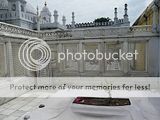
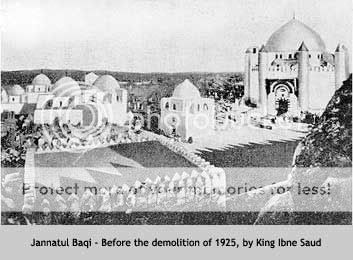
We noted earlier that in 1806 the Wahhabi army occupied Madina Munawwara when they left no religious buildings, Masjids, Baqi graveyard, etc., undemolished. The Wahhabi army’s destruction campaign targeted the graves of the martyrs of Uhud, the mosque at the grave of Sayyid al-Shuhada’ Hamza bin Abdul Muttalib and the mosques outside the Baqi’: the Mosque of Fatima al-Zahra, the Mosque of al-Manaratain, and Qubbat’ al-Thanaya (the burial site of the Prophet’s incisor that was broken in the battle of Uhud). The structures in the Baqi’ were also leveled to the ground and not a single dome was left standing. This great place that was visited by millions of Muslims over many centuries became a garbage dump, such that it was not possible to recognise any grave or know whom it embraced.
We noted earlier that in 1806 the Wahhabi army occupied Madina Munawwara when they left no religious buildings, Masjids, Baqi graveyard, etc., undemolished. The Wahhabi army’s destruction campaign targeted the graves of the martyrs of Uhud, the mosque at the grave of Sayyid al-Shuhada’ Hamza bin Abdul Muttalib and the mosques outside the Baqi’: the Mosque of Fatima al-Zahra, the Mosque of al-Manaratain, and Qubbat’ al-Thanaya (the burial site of the Prophet’s incisor that was broken in the battle of Uhud). The structures in the Baqi’ were also leveled to the ground and not a single dome was left standing. This great place that was visited by millions of Muslims over many centuries became a garbage dump, such that it was not possible to recognise any grave or know whom it embraced.
It was at about this time that Muslims who did not follow the Wahhabi Creed were prevented from performing the Haj. The Syrians were not granted permission for the pilgrimage. A year earlier IN 1805, the Iraqi and Iranian Muslims were refused permission to perform the Haj while a year later the Egyptians were not granted permission for the Haj! This was in stark contravention of the injunction of the Holy Quran in Surat al-Baqara: And who doth greater wrong than he who forbiddeth the approach to the sanctuaries of Allah lest His name should be mentioned therein, and striveth for their ruin. As for such, it was never meant that they should enter them except in fear. Theirs in the world is ignominy and theirs in the Hereafter is an awful doom. [2:114]
Destruction of Hijaz by the Wahhabis continued even thereafter in 1924 and 1925. On April 21, 1925, the monuments at the Madina Baqi’ were demolished once again by the Ikhwan, loyal to King Ibn Saud of Saudi Arabia, along with the tombs of Muhammed’s (sal Allahu alayhi wasallam) family members in Mecca.[7] The Prophet’s mosque in Medina was bombarded and assurances given by Ibn Saud that it would be restored were never fulfilled. Promises that Hijaz would be transferred to an Islamic multinational government were likewise unfulfilled.[4] 1926 saw Muslim protests across the world decrying the Saudi actions.[4] The grave of ‘Abd Allah ibn Abd Muttalib (554-570 c.e.) the father of Prophet (sal Allahu alayhi wasallam) was in Dar al-Nabigha of the Bani Najjar, the house of where the Prophet (sal Allahu alayhi wasallam) learned to swim. However, the grave was exhumed 17 years ago and transferred to the Baqi’. The area of the house today lies under the marble covering the plaza surrounding the mosque. The Mashrubat Umm Ibrahim—which was built to mark the location of the house where the Prophet’s (sal Allahu alayhi wasallam) son, Ibrahim, was born to Mariah, his Egyptian wife—also contained the grave of Hamida al-Barbariyya, the mother of Imam Musa al-Kazim. These sites were destroyed over the past few years. SITES UNDER THREAT: The Prophet’s Mosque in Medina is where Mohammed, Abu Bakr and the Islamic Caliph Umar ibn Al Khattab are buried. A pamphlet published in 2007 by the Saudi Ministry of Islamic Affairs, endorsed by Abdulaziz Al Sheikh, the Grand Mufti of Saudi Arabia, stated that “the green dome shall be demolished and the three graves flattened in the Prophet’s Mosque.” This sentiment was echoed in a speech by the late Muhammad ibn al Uthaymeen, one of Saudi Arabia’s most prominent Wahhabi clerics: “We hope one day we’ll be able to destroy the green dome of the Prophet Mohammed”.[8]
Shaykh as-Sayyid Yusuf al-Rifa’i (b.1932/1351) wrote Nasiha li Ikhwanina ‘Ulama’ Najd [Advice to Our Brothers the Scholars of Najd] which has been translated into English by Shaykh Haddad for the benefit of the Muslims and the English speaking world. According to some of the excerpts therein we learn how the Shaykh has admonished the Ulema of Najd. He says: You have wreaked destruction on the historical vestiges of the Prophet sal Allahu alayhi wasallam and those of his most honorable Companions may Allah be pleased with them all) in Madîna al-Munawwara especially and the two Sanctuaries generally. Nothing seems to remain of these vestiges anymore except the Prophetic Mosque itself. Yet, in our time, the nations of the world pride themselves in and preserve their historical vestiges as a memento, a lesson, a meaningful sign of their time-honored past. But you consider that every vestige that is stopped at for perusal or visit, is a partner [worshipped] together with Allah (swt) But Allah (swt) Himself ordered us to travel the earth to see the vestiges of the idolaters and derive lessons from them, such as ‘Ad and Thamud, found at Dîyar Salih, al-‘Ala’, near Madîna al-Munawwara, which are still visited sites, as Allah (swt) said: [Systems have passed away before you. Do but travel in the land and see the nature of the consequence for those who did deny (the messengers)] (3:137). [Have they not travelled in the land to see the nature of the consequence for those who disbelieved before them? They were mightier than these in power and (in the) traces (which they left behind them) in the earth. Yet Allah seized them for their sins, and they had no protector from Allah. That was because their messengers kept bringing them clear proofs (of Divine sovereignty) but they disbelieved; so Allah seized them. Lo! He is Strong, Severe in punishment] (40:21-22). [Has not the history of those before you reached you: the folk of Noah and (the tribes of) ‘Ad and Thamud and those after them? None but Allah knows them. Their messengers came unto them with clear proofs, but they thrust their hands into their mouths, and said: Lo! we disbelieve in that wherewith you have been sent, and lo! we are in grave doubt concerning that to which you call us] (14:9). Why then do you deprive the Muslims from witnessing the sign-posts and vestiges of the battles of Badr, Uhud, Hudaybiya, Hunayn, al-Ahzab, and others of the Days of Allah in which He gave victory to His Messenger and righteous servants, routing idolatry and the polytheists? Fear Allah, and be among those endowed with hearts so that, perhaps, you will be granted mercy!
Further down, he says regarding a recent elimination of a vestige: There was a vestige at the spot where the Prophet’s (sal Allahu alayhi wasallam) camel alighted in the mosque of Quba’ when he emigrated to Madîna, at which location was revealed the verse[10] [A place of worship which was founded upon duty to Allah from the first day is worthier that you should stand to pray therein, wherein are men who love to purify themselves. Allah loves the purifiers] (9:108). You eliminated this vestige which we used to see until recently. Regarding the Defacing Masjid al-Qiblatyn he says: There used to be, in the Mosque of the Two Qiblas, a marker indicating the old qibla and the abrogated direction of prayer towards the Farthest Mosque [in al-Qudus, Sham], so you eliminated it on the grounds that you consider it an innovation.
 Then he writes about the Razing the Gardens and Wells of the Companions ®: You eliminated the garden of the Sahabi Salman al-Farisi ® which contained a datepalm-tree planted by the Prophet (sal Allahu alayhi wasallam) and you destroyed the well of al-‘Ayn al-Zarqa’ near Quba’ and the well of Aris – the “well of the ring.[11]" You also forbade sighting of the well of Ruma which ‘Uthman ® had bought from a Jew and turned into a permanent endowment for the Muslims in the way of Allah (swt). There are many other important vestiges that were either eliminated or defaced and changed. Regarding the razing of Abu Ayyub al-Ansari’s ® house the Shaykh says: You wreaked destruction on the house of the great Companion Abu Ayyub al-Ansarî ® who hosted the Prophet – Allah bless and greet him and his Family – upon his arrival in Madîna al-Munawwara before the building of his noble apartments. All the periods that preceded yours have preserved this vestige, including your immediate predecessors. But you destroyed this most noble vestige which used to be in the qibla of the most prayer-niche (mihrâb) of the noble Prophetic Mosque on the pretext that “the polytheist Muslims” derived blessings from it!! The Shaykh also writes about the Wahhabi destruction of an invaluable library near the house of Abu Ayyub al-Ansari ®: You destroyed, near the house of Abu Ayyub al-Ansarî ® the library of Shaykh al-Islam ‘Arif Hikmat which was filled with priceless books and manuscripts.[12] Its fine Ottoman architecture was unique. You destroyed all of the above when it was far from the enlargement of the Sanctuary and had nothing to do with it. Finally he sums as follows regarding the destruction of Madina Munawwara:
 You also destroyed the well of Bir Ha’ inside the enlargement area, leaving no trace of it nor marker indicating its former existence. The Prophet (sal Allahu alayhi wasallam) entered it as mentioned in Sahîh al-Bukhari and elsewhere.[13] You spared none of the vestiges of al-Mustafa (sal Allahu alayhi wasallam) and his Companions ® in Madîna, only the Prophetic Mosque.

Even regarding the Prophet’s (sal Allahu alayhi wasallam) Mosque and the Green Dome a Wahhabi named Muqbil ibn Hadi al-Wadi who was a student of the Islamic University of Madina submitted his research paper entitled About the Dome Built over the Grave of Messenger (sal Allahu alayhi wasallam). This was sponsored by Hammad al-Ansari, "the defunct Shaykh of the anthropomorphists in Madina and a venal mercenary from Mali" according to Sayyid Yusuf al-Rifa`i. In this paper Muqbil openly and shamelessly advocated that the Noble Grave be brought out of the Mosque since he deemed the presence of the Grave and the Noble Dome there as major innovations and asks that both be destroyed. This man was granted high marks by the authorities. Sayyid Yusuf al-Rifa’i points out that this was the man who had directed hundreds of his likes, followers and imitators to bear arms and destroy the graves of pious Muslims in Aden and Yemen a few years ago when they roamed the land spreading corruption and ruin, digging up the graves of the dead with picks and spades until they brought out the bones of some of the dead and violated their sanctity. They caused a deaf and blind dissension….The Shaykh thunders at the Najdi Ulema in his Nasiha: Do you honor those who challenge the Messenger of Islam, the Beloved of Allah, the Mercy to the Universes and His Intimate Friend?!
Again, how this upstart Wahhabi came to the conclusion that building the dome was a bida‘ or that the grave needed to be taken out of the Masjid-e Nabawi needs a critical review. Is he more knowledgeable about Islam than the illustrious Sahaba ® of the Messenger of Allah (sal Allahu alayhi wasallam), who did not object and in fact paid great respect to the Messenger of Allah (sal Allahu alayhi wasallam) by visiting his grave? Further, why should two of his closest companions should choose to be buried next to him. Does Muqbil ibn Hadi know more than Hadrat Abu-Bakr ® and Hadrat Umar ®?
The question that Muslims must ask is: what right do the Saudis have to do whatever they like to these sites? The Saudis do not own the Haramayn; they are usurpers of the Arabian Peninsula, whose name they have illegally changed to “Saudi” Arabia. This is bida: Allah's Messenger named this land the Arabian Peninsula (Jazeerat al-Arab). In their zeal to impose their own distorted version of Islam on everyone, they have embarked on wholesale destruction of Islam's historical sites. In the recent past, the city planning board of Madinah changed the colour of the famous Green Dome of the Prophet's (sal Allahu alayhi wasallam) Mosque and painted it silver. The green dome identifies and symbolizes the Prophet's (sal Allahu alayhi wasallam) grave; due to the Mosque's expansion, it has now been surrounded, yet it is a unique visual focal point. Was the purpose to pave the way for its destruction, since most Muslims might not even realize what had happened if they hear or notice that a silver dome has been destroyed in Masjid-e Nabawi? After all, a number of silver domes in the Masjid-e Nabawi have already been obliterated using the pretext of expansion and renovation. Intense protests by concerned citizens forced the board to restore the Dome to its original color, but it would be wrong to conclude that the Wahhabis have realized the error of their ways.
Regarding the ploy of the Wahhabi Ulema to stop people from visiting the Janntul Baqi, the Shaykh addressed the Ulema of Najda further as follows: “You strove to commit a major innovation in which none preceded you, not even those who adhered to your doctrines and methods before you: striving to close down the noble Baqi‘ cemetary, prevent burial in it, and redirect the burial of the new dead to another spot “far from the place of idolatry and innovations,” as you put it, so as to stop people from entering al-Baqi‘ and visiting whoever is in it of the Prophetic relatives, the Companions, the Successors, and the rest of the Righteous. Allah (swt) brought your endeavors to nought, causing someone to inform King Fahd, the Custodian of the Two Sanctuaries, of this plan. Whereupon he rejected what you were planning and ordered that al-Baqi‘ be enlarged so as to eliminate your pretext that it became too full to accommodate more Muslim burials.”
In Medina, of the seven mosques at the site of the Battle of the Trench (Jabal al-Khandaq), where Sura al-Ahzab was revealed, only two remained. The others have been demolished and a Saudi bank’s cashpoint machine has been built in the area. The remaining mosques were to be demolished as soon as the new mosque being constructed is ready to replace them. One of the mosques slated for destruction was Masjid Fath, the mosque and rock of victory, where the Prophet stood during the battle of the trench praying for victory. On the rock is where he received God’s promises of victory and of the conquest of Mecca. On 10 September 2004, after the demolition of the famous Seven Mosques of Fatimah,‘Ali,Salman al Farisi, Abu Bakr, ‘Umar, al Qiblatayn and al Fath, Muhammad al Dubaisi writing in al Madinah highlighted that the “destruction of these mosques has deprived Madina Munawwara of one pillar of its immortal history”. In response, Salafi writer Saleh al Fawzan justified the destruction of the historic mosques.[10]

On the al-Muwajaha al-Sharifa or the Jali Mubarak on the Roza-e-Rasool Allah (sal Allahu alayhi wasallam) the words YA ALLAH YA MUHAMMAD were visible for centuries. The Wahhabis have mutilated YA MUHAMMAD in a way that it now reads as YA MAJEED. On the Qibla side, the brass partition that is divided into three sections between two columns, the authorities have also tried to cover the famous two verses inscribed in the east from the story of al-‘Utbi as mentioned by Ibn Kathir in his Tafsir. “O best of those whose bones are buried in the deep earth, and from whose fragrance the depth and height have become sweet! May I be the ransom for a grave in which you dwell, where purity, bounty and munificence.” There are qasidas written by rulers of the Muslim world, such as Sultan ‘Abd al- Hamid. Many verses of the famous Burda of al-Busayri had also been painted over. If one raises his head a bit, he will see on the first section of this partition a green banner, on which the words of the Almighty are framed in yellow: O you who believe! Raise not your voices above the voice of the Prophet, may blessings and peace be upon him and his family, nor speak aloud to him in talk, as you speak aloud to one another, lest your deeds be rendered fruitless while you perceive not. (Qur’an 49:2)
The Sacred Chamber has four exterior doors: on the south, Bab al-Tawba (The Door of Repentance), on thenorth, Bab al-Tahajjud (The Door of Night Prayer), on the east, Bab Fatima (the Door of Fatima), and on the west, Bab al-Nabi (The Door of the Prophet)—also known as Bab al- Wufud (The Door of Delegations). These gates have been present since the year 668 AH except for the Gate of the Night Prayer, which was installed in 729 AH. Inside there are two gates, one on either side of the triangular part of the interior compartment. All of these doors are covered by brass shelves holding Qur’ans, an attempt to prevent the public from looking inside the Sacred chamber. Outside, the police are on the look out for the visitors who raise their hands as in Fateha or those who remain unduly long before the Rowza-e-Rasool (sal Allahu alayhi wasallam). They remain with their backs to the Jali Mubarak of the Rauza-e-Rasool all the time without an iota of respect for the Messenger of Allah (sal Allahu alayhi wasallam). As Shaykh Yusuf al-Rifa’i picturesquely points out in his Nasiha to the Najdi Ulema: “You have brought hirelings and ignoramuses whose only skill is frowning and placed them at al-Muwajaha al Sharifa with their backs turned to the Elect Prophet, peace and greetings be upon him. They turn their backs and rear ends to him, facing his visitors and all Muslims with sour faces full of spite, giving them sinister looks and taunting them with charges of idolatry and innovation, almost attacking them physically. They rebuke this one, bark at that one, hit the [supplicating] hands of the third, raising their voices to censor and blame, ignoring and forgetting the saying of Allah, { O you who believe! Raise not your voices above the voice of the Prophet, nor shout when speaking to him as you shout to one another, lest your works be rendered vain while you perceive not. Lo! They who subdue their voices in the presence of the Messenger of Allah, those are they whose heart Allah has proven unto righteousness. Theirs will be forgiveness and immense reward. Lo! Those who call you from behind the private apartment, most of them have no sense." [49:2-4].” As for women, they are forbidden by the Wahhabis from reaching the Muwajaha Sharifa and greeting the Prophet (sal Allahu alayhi wasallam).
Also, near Sayyiduna Ameer Hamza ® burial grounds, there is a Masjid on the “Mihrab” (prayer niche) of which there are two inscriptions which originally read in Arabic as “ALLAH” on the right and “MUHAMMAD” on the left. Today, the name “MUHAMMAD” has been scribbled out. (Please watch http://www.youtube.com/watch?v=RpynlYeM-H4) The commentator while addressing the Wahhabis rightly puts a poser: Will you able to drop the name of MUHAMMAD from the Kalima or from the Holy Qur’an too! Abandon ye the works of the Devil! The former Masjid at Uhud was destroyed by the Wahhabi brigands.
Shaykh Sayyid Yusuf al-Rifa'i puts three questions to the Najdi Scholars: "Why did you not turn to Khaybar and other places? And is it permissible to imitate the Jews who destroy and eliminate every Islamic vestige in al-Qudus al-Sharif , by erasing our own vestiges in al-Madina al-Munawara? What have you left of our glorious heritage for future generations?"
Shaykh Sayyid Yusuf al-Rifa'i puts three questions to the Najdi Scholars: "Why did you not turn to Khaybar and other places? And is it permissible to imitate the Jews who destroy and eliminate every Islamic vestige in al-Qudus al-Sharif , by erasing our own vestiges in al-Madina al-Munawara? What have you left of our glorious heritage for future generations?"
To continue, Insha Allah…
NASIR