A VERY WARM WELCOME VISITORS
Showing posts with label Ibn Taimiyya. Show all posts

Saturday, September 13, 2014

Part 2: There's Baraka in the Awliya Allah's Graves.

Part 2: THERE’S BARAKA IN THE AWLIYA-ALLAH GRAVES.

From the Layman’s Desk: Islamic Article No.17:
        
In the Name of Allah, Most Beneficent, Most Merciful.
Praise be to Allah, Lord of all the worlds, and blessings and peace of Allah upon His Prophet and Messenger Muhammad (sal Allahu alayhi wasallam), his Family and all his Companions.

Allah has bestowed upon His favorites, a great importance, and therefore, our Shariah urges Muslims to be in touch with the pious persons and wants to remain this connection till the last moment of life.  It is the consensus of the Muslim scholars that the miracles of saints are absolutely true and correct.  In various places the Qur’an has pointed out the miracles, and the Ahadith of the Prophet (sal Allahu alayhi wasallam) have mentioned them, and only innovators and their followers are the people who deny the miraculous power of saints.  [al-Mukhtasar al-Fatawa al-Masriyya by Ibn Taimiyya]

Imam Sawi, while commenting on the verse "And seek a means of approach to him" ( 5:35 ), writes: "To say that Muslims who visit the graves of the saints are Kaafir because you believe they are worshipping other than Allah is a sign of clear heresy. To visit the saints is not worshipping other than Allah, rather it is a sign of loving those whom Allah loves" (Tafseer Sawi, vol.1 p.245).  Therefore, from the commentary of Imam Sawi we learn that visiting the graves of the saints is permissible, and that it is not worshipping other than Allah but it is loving those whom Allah loves.  As Shah Waliyullah states: “To love the symbols of Allah the Exalted, means to love the Qur’an, the Prophet (Salla Allahu Ta’ala Alayhi Wa Sallam) , and the Ka’ba, or to love anything that reminds us of Allah the Exalted. To love the Awliya of Allah is the same.”  [Hujjat Allahi’l Baaligha;  Altaaf al-Quds – The Sacred Knowledge (Persian)]

Shaykh Abdul Haq Dehlwi (d. 1052 H.) writes: "To visit graves is by consensus a mustahab (preferable) action" (Ashi'atul Lum'aat, vol.1, p.715)  He also writes: "When visiting the dead, respecting them is Wajib (necessary) especially where the pious are concerned. As it was necessary to respect them whilst they were alive, similarly, it is important to show them respect at their graves. This is because the help which the pious give depends on the respect that people who visit them show to them". (Ashi'atul Lum'aat, vol.1 p.720).  From these writing, it is absolutely manifest that the belief of Shaykh Abdul Haq was that to visit the graves is neither Shirk nor Bid'ah. Moreover, it is a preferable act and the visitor is blessed with the help of the inmate of the grave.

Shah Waliullah Dehlvi in his book Faizul Haramain, Page No: 57  states:  "If someone achieves mystical knowledge then his soul become so powerful that Tariqah, Maslak, Saintly chain, Lineage, Genealogy, Relations and everything connected with that person comes into the range of his favor and inclination.  The favor of Allah reflects through his spiritual attention".  And in his Persian book, Hama’at:  "This guarantees for the regular attending on death anniversaries (Urs) of the saints.  Regular visits to their  shrines  to recite Fatiha there, distribution of charity, to honor his offspring, relations and relics are lawful in Shariah; and also these are supererogative (Nafl and Mustahab) actions."

To say that Shah Waliullah muhaddith (rh) criticized those who visited the mazaars is but attributing lies to him.  According to the experts,    the deviants have attributed false books (such as al-balagh al-mubeen), as well as carried out mass fabrications, interpolations, extrapolations and deletions in Shah Waliullah Dehelvi’s books such as the Persian book al-Tafhimat al-Ilahiyya. This was done with a view to making his works agree with the teachings of the Najdi Shaykh as well as Shah Ismail whose followers were in the forefront in committing these forgeries.    However, even a staunch Wahhabi such as Suleiman Nadwi has, in his own books, admitted to these fabrications.  The fact remains that Shah Waliullah followed the Naqshbandi silsila,  celeberated mawlid, visited graves of awliya often for maraqaba, used to recite dua ( supplication) having words of Istighatha, did fatiha on food , used to give amulets containing verses from Qu'ran and Hadith.  And so did his more famous son, Shah Abdulaziz Muhaddith al-Dehlwi.

Therefore, when we track the Islamic hagiography including the Classications and Generations (Tabaqaat), Remembrances, Recollections (Tadhkira), Marvellous Deeds or Feats (Manaqib),  Spiritual qualities (Fadhail) of Prophets and Saints, and Life Story (Sira) of Hadith Masters (Muhaddithun) and persons of religious knowledge (Ulama’) we do come across instances in many of them that the burial place of so and so Wali-Allah or a Hadith scholar or a pious person, is full of Baraka where the dua’ is accepted by Allah.

The graveyards become more blessed when pious people are buried there.  This in turn strengthens the motive to visit such a graveyard to participate in and obtain some of those blessings and divine mercy.  That’s the reason why some graveyards such as Jannatul Baqi and Jannatul Mua’la are held in highest esteem.  In his book "al-Hisn-ul-Hasin" and its summary "Uddat-ul-Hisn-il-Hasin", Hafiz, Muhaddith, the Shaykh of the Qurra' (Reciters of al-Qur'an) and student of Ibn Kathir, Shams-ud-Din Ibn al-Jazari,   mentioned that the graves of the righteous are among the places of having the dua' fulfilled.

A Hadith which demonstrates the existence of blessing at the graves of the righteous is the one wherein the Prophet (sal Allahu alayhi wasallam) says that every person'a grave would either be a garden from Paradise, or a pit from the pits of Hell.
[Tirmidhi (Kitab Sifat al-Qiyama, #2384) with a Da'if chain, Bayhaqi in his Shu'ab (1:360) and 'Adhab al-Qabr, Tabarani in his Kabir (from Abu Sa'id) and Awsat (8:273 #8613), Abu Nu'aym (8:87), Ibn 'Asakir (42:497), Ibn Abi Dunya (K.Qubur, #122), Ibn Mandah, and Daylami (Firdaws, 1:438 #1445, 3:283 #4717, 4:471 #6861).]  Cf. Sakhawi's Maqasid (#758), where he says it is Da'if. However, there are numerous supporting narrations that strengthen the meaning of this Hadith (such as Abu Ya'la #6644, Ibn Hibban #3122, Muslim #5110).

Sayyidi Arwaasi (reh) informs us that 'Allama Shams ad-din ibn an-Nuaym (rahmat-Allahi 'alaih), a Hanafi scholar, wrote in Kitab ar-Ruh: 'Souls may be in a different state other than when they are in their bodies. The souls of awliya' are at Rafiq al-ala and also have a relation with their dead bodies. If a person visits such a wali's grave and greets him, his soul at Rafiq al-ala answers that person.' This is also noted in al-Imam as-Suyuti's Kitab al-Munjali. All these proofs show that awliya' have powerful tasarruf (disposal) and influence after their death in a way which we may not know.  It is necessary to believe that the tasarruf (disposal, possession) of their souls is by Allahu ta'ala's tasarruf on them.

Imam Maalik stated: “I have learned that souls are free. They come and go wherever they wish.” [Narrated by Ibn Abi-al-Dunya in his book Dhikr al-Mawt and confirmed by Ibn-Taymiyyah in his Majmu al-Fatawa 4/294].

The soul can and does come. Events and observations bear witness to this fact.   According to Salman al-Farsi ® “The Arwaah of Mum’inin live between heaven and earth (i.e. the dimension of Barzakh) and they can go wherever they want.” [Narrated by Ibn-al-Qayyim in Kitab-ar-Ruh, p. 144).

This is also confirmed by Ibn Hajar Haytami and Imam Suyuti – among many others. Ibn Hajar Haytami states in his Fatawa Hadithiyya (Pg: 393): “Imam Yafi`i said: ‘… And they [the awliya] saw the Prophets (Allah bless them all) … which was like the vision of our Prophet (Allah bless him and grant him peace) towards the congregation of Prophets in the heavens – and he heard and spoke to them. Verily, whatever is permitted for the Prophets as a miracle is permitted for the Saints as a miracle also.’ 

Ibn Mulaqin said: ”There have been numerous visions of the Prophet (Allah bless him and grant him peace), both in a state of wakefulness and sleep. The narrations in connection to this regarding [the vision of] the Friends of Allah are extremely plentiful and none denies them except one who is stubborn and dead.”  Ibn Hajar goes on to discuss the modality of such a vision, the permission of the souls of the Prophets to leave their graves, the fact that the vision of numerous people of a given prophet at a given moment is possible (he contrasts it to the sun), and how this does not make one a companion.  This is the position of those spiritually realized… They have removed the veils from their eyes within this world such that their “vision is piercing” (Quran) and therefore witness and see what many of us cannot.

Allamah Alusi (reh.) has proven that many pious people have seen the Holy Prophet (sal Allahu alayhi wasallam) in the state of wakefulness and received knowledge from him. In Ruh al-Ma’ni he mentions such instances and the references that involved Hadrat Shaykh Abdul Qadir Jilani ®, Shaykh Ibn Ataullah and Shaykh Abul Abbas al-Mursi. Imam Ghazali (reh) stated: “Countless matters were disclosed to me during these seclusions. What I will mention though for the benefit of others is that I realized for sure that the Sufis are the seekers in Allah's Way, and their conduct is the best conduct, and their way is the best way, and their manners are the most sanctified....and indeed they witness the Angels and the SOULS OF THE PROPHETS while awake, and they hears their sounds, and derive benefits from them." (al-Munqidh min al-Dalal, p. 131).

Ibn Hajar al-Asqalani writes: Abd al-Wajid says that I saw the Prophet, (May Allah bless him and grant him peace), in a dream with his companions waiting at this place, like they were waiting for someone. I said, "As Salaam 'alaykum," after the reply to the salaam I asked "what or who are you waiting for?" The reply was we are waiting for Imam Bukhari, and that was the day Imam Bukhari passed away. [Fath al Bari, chapter on the death of Imam Bukhari, and Tarikh Baghdad by Hafidh Asqalani and Khateeb Baghdadi] 

In Tarikh ibn Kathir in the Chapter on Karbala, Hafidh Ibn Kathir writes: Abdullah Ibn Abbas, may Allah be pleased with Him, said that in his dream he saw the Prophet (May Allah bless him and grant him peace), and upon him there was dust from travelling. In his hand’ was a bottle in which there was blood, I asked him: “what is this?” He replied, “My grandson Hussain and his companions have been martyred, and I have collected the blood spilt by them and I shall present this blood to Allah Ta'ala.” This is an authentic narration.   Ibn Kathir also mentions that Ummul Mu’ mineen Salma states: I saw the Messenger of Allah, (May Allah bless him and grant him peace), in my dream, there was dust upon his hair and beard, I asked him: “O Messenger of Allah why is there dust on you?” He replied: 'I am returning from Kerbala. Of course, there are many such instances right from the time of the Sahaba, as is evident from the many ahadith and other Islamic litertures.

Incumbent upon all Muslims to respect the Awliya-Allah:

The scholars list tormenting or troubling the Awliya-Allah as a major sin since doing so can lead to kufr and is foreshadowed with a dire threat. Imam Dhahabi writes in his book Kitabul-Kabair, "The 51st major sin is tormenting the Awliya-Allah and bearing malice against them. Allah says: Verily, those who annoy Allah and His Messenger, Allah has cursed them in this world, and in the Hereafter, and has prepared for them a humiliating punishment. And those who annoy believing men and women undeservedly, bear on themselves the crime of slander and plain sin. (Ahzaab 57:58) The Blessed Prophet (sal Allahu alayhi wasallam) stated that Allah said, "I have declared war upon him who makes an enemy of my wali." (Bukhari) And in another narration of Bukhari, "He invites Me (Allah) to war." And really, what could be a greater threat than the fact that one is inciting war with Allah? Nothing indeed is so damning as to declare war against Allah except for the person who deals in usury. It is obvious that a person whom Allah declares His enemy can never succeed (may Allah I save us). The consequences of declaration of war against Allah Subhanahu Ta’la can be nothing less than dying in kufr. May Allah save us from this through his infinite kindness and mercy.

It is incumbent upon all Muslims to respect the sanctity of the Awliya-Allah and not to disregard their relics. One day shortly after the insurrection began against him, Uthman (R) was delivering a Khutbah in Masjid Nabawi.  A Ghafari man stood up, snatched the staff from the hand of Uthman ® and snapped it in half on his knee. Not a year had passed after that the the lost the sensation in his leg and died soon thereafter. (Sunan Saeed Bin Sakan)

In his Jami’ul Karamat il-Awliya Imam Nabhani mentions that Imam `Abdul Wahab Sh`arani stated, “Our brother Shaykh Salih al-Hajj Ahmed Halabi [may Allah sanctify his secret] informed me that his house was in the vicinity of the blessed mausoleum of Shaykh Muhyuddin ibn `Arabi.  It was visible from his house.  One night after the `Isha prayer, a person advanced towards the tomb with a fiery torch in his hand, with the intention of burning the bier.  When he was 8-9 metres away from the grave, he started sinking into the ground, so much so that he disappeared in the ground. Late night, when his family members could not find him anywhere, they started looking out or him. When the shaykh narrated them the entire incident, they reached the place where he had sunk. When they dug up the place, they found his head. But as they went on digging, his body kept sinking on further. After much digging up, they finally gave up, covered his body with mud and went away.”

Hazrat Khwaja  Moinuddin Hasan Chishti Sanjari ® has narrated:

“There was a man who hated the Awliya.  When he died, and was placed in the grave, the people tried to turn his face towards the Qibla, but it would always turn away from that direction. The people were astonished at this action.  There was a voice from nowhere announcing, ‘It would be a futile  exercise to try to turn his face toward the Qibla, because he used to turn  his face away at seeing the Awliya, and that he who would turn his face in disgust from My friends, I will turn My face on him.  He is a condemned soul, and on the day of judgement, such people will appear with faces of donkeys.” 

A miscreant relieved himself on the grave of Hasan (R).  Right after that he went mad and died.  (Endless Bliss, 5the facs.)  

The above are just a very incidents that warn us against harbouring evil thoughts or insults towards Allah Awliya.  But they are enough to show that the wrath of Allah does visit on the enemies of Awliya-Allah. 

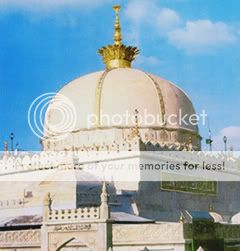
As an Islamic scholar states:  The hearts that are in Allah rememberance are alive even when they depart to the barzakh, they are like fish in water, and the aura/radiation of certain dead awliya are so profound and strong, that even lay people when visiting them in their graves, feel their personality qualities and characteristics when they were in this world, for example sayidina Moinuddeen Chisti, those who visit his grave in Ajmer, find a dominating effect of parental love, attention and care directed at them in that place, which was a character of Sayidina Chisti to those around him when he was present in this world.

Continued in Part 3.

NASIR

Sunday, May 2, 2010

MIRACLES-ISLAMIC PERSPECTIVE IN BRIEF- PART 10.

From the Layman’s (Nasir Ali) Desk:7 – Miracles, Islamic Perspective in Brief:

Part 10 – Continued:


In the Name of Allah, Most Beneficent, Most Merciful.


If Allah does not give Noor to someone, he cannot become enlightened (“Munawwar”) – Qur’an, Surah Noor, v.40


Let us refer to some more miracles: Tayy al-Musaafa:

Shaykh Abd al-Haqq Muhaddith Dehelwi states in Madarijun Nabuwat:

“Allah the Exalted has given the Holy Prophet (sallal laahu alaihi wassallam) the strength and power to go anywhere he likes; he can go with his own body or only in soul, on the earth, in the sky, in the grave, while maintaining connection with his own shrine.”


In Tafseer Roohul-Bayaan, it is mentioned that Imam Ghazali said: The Holy Prophet (s) and his Companions’ souls have been the right to travel the world and many Awliya-Allah have seen the Prophet (sallal laahu alaihi wassallam). Hence, the Holy Prophet (sallal laahu alaihi wassallam) is conscious of the believers and observes them by Divine leave.


In the physical world, some pious believers who include the Awliya-Allah are able to traverse great distances in moments. This is called Tayy al-Musaafa. But as we are not discussing prophets and angels miracles about the speed and so we won’t cite those examples, including the incident of Night of Isra and Ascension.


In the book, Wahhabiyya, it is written: “Traversing long distance in a moment is a Karama bestowed upon Awliya. It is ‘Wajib’ to believe in this.”


Therefore, prophets and Awliya, as well as angels are able to traverse great distances within short time. Spiritual power being unconstrained by space and time such occurrences also occur with the permission of Allah in the cases of prophets and Awliya and pious people who have assumed a veil of departure from this material world.


Sahl bin Abdullah, a great and venerable Sufi, was known for his self-mortification and ascetic training. He has been quoted as saying that he heard from a saint (Wali) called Abdallah bin Salih that every ‘Kaamil’ (complete) saint gather in Makkah every Thursday evening, i.e. the night of Jumma’ and it was for that and the reason that countless blessings and mercies descend on the city when angels perform the ‘Tawaaf’ (circumambulation) of the Baitullah day and night, and since he has seen wonders there that he had stayed awhile longer than his practice. Among the wonders he haad seen was regarding one called Maalik bin Qasim Jili whom he asked why did his hand smell of cooked meat when he replied that he had in fact not eaten for the entire week but that he had just fed his mother way back home and buried back to catch the Fajr prayer with the gathering. He had in fact travelled 900 ‘Farsakh’ or 2700 miles between his home and Makkah in a short span of time. After relating this wonder, Abdullah bin Salih asked Hazrat Sahl bin Abdullah whether he believes him. When the latter replied in the affirmative, the former exclaimed: “Praise be to Allah! I have found one Mumin person.


From the above incident it is evident that even in the physical world of ours it is possible for a Friend of Allah or a pious believer to travel long distances in a short period of time or within moments.


In fact there are numerous accounts given in the Rowdh and other Islamic literature where not only the time for travel is reduced to moments but the ground beneath the feet itself is not felt or if felt, it is as if walking on the “rolling waves”; or the shoes being dry despite walking on the rain-soaked muddy mire (e.g. as stated by Hazrat Data Ganj Baksh about his Shaykh.) In Kashful Mahjub, he mentions the narration of Abu Warraq’s regarding his journey along with his Shaykh al-Hakim (Muhammad bin Ali Tirmidhi) from Tirmidh to the Desert of Bani Isra’il and back within a short time so that the disciple could not restrain himself from asking his Master: O Shaykh, O Shaykh, how did we reach the Desert of Bani Isra’il from Tirmidh in such a short time?” The answer that he got was: It is your business to arrive (‘rasidan’) and not to ask questions (‘pursidan’).


We are informed by the author of Kashful Mahjub, Hazrat Ali bin Uthman al-Hajweri (Data Ganj Baksh ®) that once he went to pay his respects to Baab ‘Umar and his old wife Fatima so that the Shaykh who was one of the Awtaad (high-ranking saints or officers of the Divine Court who have the power to loose and bind) might look on him with kindness. For this he had to travel from Uzkand to a remote village Ashlaatak in Farghana. He was surprised to learn that the Shaykh had been continually seeing him from the day of his initiation to the path. The Shaykh also informed him that travelling distance (Tayy al-musaafa or sipardan-e-musaafat) is child’s play. He bade his wife to bring them something to eat, when she brought some fruits which could not have been procured during that season and in that village. The Shaykh advised him to pay visits by means of thought.


Ibn Hajar Haytami (Reh.) wrote in his Fatwa:  “The number of those who have said that if a Wali goes to a very distant place in the west (in a short time) after having performed the evening salaat, and if the sun has not set there yet, he does not need to perform the evening salaat for the second time at that place, are many.”


Imam ar-Rabbani mentions in his Letters that some Awliya were seen far from the place where they lived and that it was the appearance of their soul in bodily forms.


Hazrat Shaykh Muhiyudden Abdul Qadir Jilani Ghousul Azam ® too had spiritual powers to go to the far-flung places instantly to the rescue of the ones in distress who appealed for his aid. In fact, even his maternal grandfather, Abdullah as-Sawma’i, was known for numerous miracles and people used to ask for his spiritual intervention in times of distress as stated in the introduction of Jila’ al-Khatir (Purification of the Mind) which contains edited discourses of Hazrat Shaykh Abdul Qadir Jilani ®. Once a caravan of a group of merchants of Jilaan while heading for Samarkand was accosted by bandits. The merchants who were unable to defend themselves invoked the intercession of the saint. Suddenly, they saw ‘Abdullah as-Sawma’i in their midst. He was reciting the formula. The bandits took to their heels and the saint disappeared as suddenly as he had appeared among them. When the merchants related the story to the people of Jilaan, they told them that the saint in fact had never left Jilaan during the time of their journey.


In his book, Lawaaqi-ul Anwaar Fi Tabqaatil Akhyaar (The Infused Lights of the Biographies of the Righteous), Shaykh Abdul Wahab Sha’rani (reh.) records an incident to show that Awliya can appear at far off places from their actual location. A disciple of Sayyidi Muhammad Ghamri ® was once passing through the bazaar when the foot of the animal on which he rode, slipped. In extreme panic he screamed: “Ya Sayyedi Muhammad, Ya Ghamri!” As if by co-incidence, Ibne Omar Saeed the ruler, who had been made a prisoner by Sultan Chiq’miq was also passing through the bazaar at the same time. He too heard the screams. He inquired of the disciple as to who was Sayyidi Muhammed ®. When he was informed about him he also screamed: “Ya Sayyedi Muhammad, Ya Ghamri!” No sooner he had proclaimed the name, than the great Wali and spiritual master appeared and drove away his captors, freeing the captured ruler. The Shaykh then departed, blessing the ruler.

Hazrat Habib al-Ajmi, the disciple of Hasan Basri ® was another Awliya-Allah who was known for Tayy al-Musaafa. Many times during the Haj season he was seen at Basra (Iraq) on the 8th day of the lunar month of Dhu’l Hijja, and on the next day on the 9th he was spotted at the plains of Arafat near Makkah. This is mentioned in Jami’s Shawahid an-Nabuwa which documents the miracles of Sahaba and Tabiian.  The distance between Basra and Makkah by flight is at least 1,238 kilometres or over 769 miles. Imagine then, that those were the days of caravan and how many months it used to take to cover that distance on land! Dhows were the other mode of transport. 

There is another classic case of Tayy al-Musafaa and this relates to Khwaja Abdul Wahid bin Zaid Abul Fadhal (d.793 c.e.) a student of Imam Abu Hanifa and disciple of Hazrat Hasan Basri and Master of Hazrat Fudhail bin Ayadh.   Abdul Wahid Bin Zaid relates:  I purchased a slave on the condition that he serves me. Once, when it became dark I looked for him in the house, but could not find him.  Early in the morning he came and presented me with a dirham. I asked, “Where did you get it from?” He replied, “I receive a dirham daily and will only give it to you on the condition that you do not ask for me at night.” He would disappear every night and return in the morning with a dirham.  One day my neighbours approached me and shrieked, “O Abdul Wahid sell your slave. He is a grave digger!” This news depressed me. After this, I decided to keep a vigilant eye on him. That night after Isha Salah, the slave stood up to leave, he pointed to the door and it opened. He made his way to the second door and did the same and then the same again to the door from which I was watching him. He left the house so I followed him till he reached a stretch of barren land.  He took off his clothes and put on a cloth sack and prayed till Fajr. He then lifted his hand towards the heaven and said, “Oh my Master, give me my small masters pay”. A dirham then fell from the sky. I was mystified and amazed at this. I stood up and performed two rakats and sought forgiveness from Allah, from the evil thought that had crossed my mind. I promised myself that on returning, I would free him.  As I made my way back I looked for him but could not find him. He was nowhere to be seen. All of a sudden a knight on an armoured horse appeared. He asked, “Oh Abdul Wahid what are you doing here?” I related the incident to him. He then inquired, “Do you know the distance from here to your city?” Oblivious to where I was, I replied in the negative. He informed me that I was approximately two years travelling distance from home. He then said, “Do not move from here till your slave returns tonight”.  When it became dark my slave came. He came with a tray full of food and greeted me with joy and said, “Eat my master, you should not have followed me here”. I ate while he prayed till Fajr. Once he had finished he held my hand and walked a few steps. Instantly we were back to my house. He said, “Oh master now that we are back, did you not make the intention to free me?” I replied affirmatively. He added, ”Free me and take the money you paid for me and you will be rewarded”. He then picked up a stone and gave it to me. I looked at it. Astonishingly it had turned into gold.  He had come to realize that his slave was not a grave-digger but a 'Noor' digger.


 Those who refuse to understand the powers that Allah bestows upon his pious believers and Awliya (not to speak of the high-ranking prophets and messengers a.s.) come out with a convenient answer that there is a Jinn (genie) behind miracles. While it is true that according to Mishkaat the Iblis on hearing the call for prayers runs thirty-six miles away from that place and comes back in an instant after the completion of the call, it is misleading to attribute the Karamaat of Awliya to the deeds of deceiving Jinns. This assertion about the Jinn being behind the miracles is far-fetched and not true. 


Tayy al-masaafa is one of the powers, among others, bestowed on the Friends of Allah by the Creator Himself and so it cannot be the handiwork of a Jinn as the deniers of Karamaat would have us believe. We have noted in the last post how Asif bin Barkhiya was not of the Jinn but a human being, “one who had the knowledge of the Book,” and yet he was instrumental in bringing the throne of the Queen of Sheba (Bilqis) before Sulaiman (a.s.) in twinkling of an eye, and thus leaving the wonders of the Jinns far behind. This is also called “Tayy al-Ardh” (Folding up of earth) that is, instead of taking a step forward towards the object, the earth turns towards the traveler rapidly no matter how far the distance. Islamic scholars have defined this as “The ceasing and termination of the matter in the initial location, and its reappearance and creation in its final location.” Otherwise too, the physical world may be restricted but the spiritual world is free from the restriction of time and place. In short, Awliya-Allah of high ranks are able to travel great distances in a short time. The term they use is “Tayy al-Makaan”.


Ibn Taimiyya says: “Sometimes the Jinn will take the form of those admired and stand at ‘Arafat and who believe well of him will think that he actually stood in ‘Arafat. Many others have also been actually carried by the devils to ‘Arafat and other sacred places.”  He further says:  “Satan is able to make such misdeeds appealing to them by convincing them that they are among the Karamaat of the righteous…”  (Al-Furqaan Bayna Awliyaa ar-Rahmaan wa Awliyaa ash-Shaytaan)


Now, at the outset the question arises why would the Satan do that by making people think that they have sighted an “admired one?” Wouldn’t that, on the contrary, strengthen the belief in miracles?  Anyway, it is significant to remember that a perfect Wali is an inheritor of the Messenger of Allah (sallal laahu alaihi wassallam), his status being proportional to the degree of Allah’s love for him. Hence the Karamaat of the perfect Wali can never be in contradiction of the Islamic letter and spirit – this too we have noted before. Suggesting that a Jinn may take the form of a Wali is mischievous and misleading.


According to Sayyidi Abdulhakim Arwasi (Reh.), the Shafi’i scholar, Allamah al-Jaili, wrote in his commentary to Sahih al-Bukhari: “The Devil cannot appear in the shapes of perfect Walis who are Rasool-Allah (s) inheritors, just as it cannot take Rasool-Allah’s (s) shape.”


Once it is accepted that a Jinn cannot impersonate a perfect Wali, the theory of Jinn impersonating Awliya-Allah for misleading people falls flat  to the ground.


Sayyidi Abdulhakim Arwasi (reh.) also informs us that according to jurisprudence and principles thereof, the ‘ulema and Awliya among the community of the Messenger of Allah (sallal laahu alaihi wassallam) are the inheritors of his every “Haal” save those which are among his “Khasais” (i.e. peculiar or special to him).


To continue…Insha Allah!


NASIR

Wednesday, April 21, 2010

MIRACLES -–ISLAMIC PERSPECTIVE IN BRIEF-PART 2.

From the Layman’s (Nasir Ali) Desk-7: Miracles –Islamic perspective in brief: Part 2.


In the name of Allah, Most Beneficent, Most Merciful.


As we noted in Part 1 of our Article, Allah declares war on the enemy of His Friend.   Ibn Taimiyya said that Allah is expressing: "I will seek revenge like an aggressive lion against anyone who comes against My saints."


There was a disciple of Hazrat Junaid Baghdadi ® who bore him a grudge and therefore left him. One day, however, he returned to the Shaykh with the intention of testing him. Hazrat Junaid Baghdadi ® was aware of the intention. So he asked him, “Do you need a formal answer or a spiritual one?” “Both,” said the disciple. Replying to him, the Shaykh said: If you had tested yourself, you wouldn’t have the need to test me. And the spiritual answer is, I depose you from the Saintship. The disciple’s face turned black immediately and the light of certainty (‘Yaqeen”) also vanished from his heart. The disciple abandoned his foolish self-conceit and implored the Shaykh to forgive him. Hazrat Junaid Baghdadi ® told him: Don’t you know that Awliya-Allah possess mysterious powers? You cannot endure their blows.” Saying this, and considering the repentance of the disciple, the Shaykh blew a breath over his face and the disciple was restored to his original self. 


Hazrat Khwaja Moinuddin Hasan Chishti ® narrated that there was a man who hated the Awliya-Allah. After he died, he was placed in a grave where the people tried to turn his face towards the Qibla. To their astonishment, as much as they tried, that man’s face always turned away from the Qibla. A voice from nowhere announced that it would be an exercise in futility trying to turn his face to the Qibla because that man used to turn his face in disgust on seeing the Awliya-Allah. “I will turn away My face from him. He is a condemned soul, and on the Day of the Judgment such people would appear with faces of the donkeys.” That is one of the ways how Allah deals with those who bear grudge against Awliya-Allah.


Of course, there are also instances when Awliya-Allah suffer the ignominy heaped upon them but they bear it without complaint – which goes to show their extreme forbearance, tolerance, and patience with the ignorant for the ‘Rida’ of Allah, depending upon their ranks.

Awliya-Allah are the persons of Ahl-e-Tassawwuf: 

Allah has exalted the status of knowledge and power of the Awliya. Allah says about them:  “Whosoever mortify themselves for Our sake, We will assuredly guide them in Our ways."

(Qur’an: 29:69).

Shaykh Hakim of Tirmidh in the second chapter of his Adab al-muridin describes such mortification or striving as a kind of door which leads to nearness to Allah. Now attaining this nearness (which is not physical) is itself not easy because it requires the mastery of bringing the carnal soul (Nafs-e-Ammaara) under control which in itself is ‘Jihaad-e-Akbar’ ( the greater Jihad) as per the famous hadith of Mohammed Mustafa (sallal laahu alaihi wassallam) which he (s) stated to his Companions while returning from a battle which he (s) merely termed as “Jihaad-e-Asghar” (i.e. Lesser Jihad).

Observance of the outer state by man is "mortification".  "Guidance" consists in Allah's maintenance of man's spiritual feelings of Inner Truth or Inner Reality.  Thus there are two aspects:  The first is the Shariat consisting of the outer state or external ordinances.  The second is what is at the heart of the revelation - which is called Haqiqat.  Shariat cannot be maintained without the Haqiqat and conversely,  Haqiqat cannot be maintained without the Shariat.  Those who uphold both Shariat and Haqiqat are called people of Tasawwuf or the Ahle Sunnat wal Jamaat that consists of the four schools of thoughts namely, the Hanafi, the Shafii, the Hanbali, and the Maliki. 

Again, regarding the Quranic verse, ittaqullah wa yu`allimukumullah ("Be aware of Allah, and Allah Himself will teach you" 2:282), Hazrat Shaykh Abdul Qadir Jilani ® points out in Discourse 16 of Futuh al-Ghaib: And fear Allah and He will teach you, then He will invest you with the power of controlling the universe with a clear permission which will have no obscurity in it... and He has done this with many of His Prophets and Awliya and people especially favored from among the children of Adam. Then there is the hadith shareef: “ man `amila bi ma `alima warrathahullahu `ilma ma lam ya`lam ("Whoso acts upon what he knows, Allah will make him inherit a knowledge that he did not have"). Hazrat Bayazid of Bistam cited this hadith in response to a question: "From where and from whom did you get this knowledge which you claim to have?"

Awliya-Allah are the people of Tasawwuf and are also called the "Sufis".  They fulfill the requirements of the 'Deen' (Religion), which consists of Islam, Imaan and ihsaan,  as aptly explained in the Hadith of Jibreel.  With the evolvement of the language, it is "ihsaan" that came to be known as "Tasawwuf" in later centuries, and the two aspects of Ihsan came to be known as Mushahada and Muraqaba, i.e one where one worships God as if he sees God; and the other where one is unable to worships God in the first way, he at least worships God knowing that God sees him.  Awliya-Allah are the most ardent defenders of  Shariat, and their path from the outer Shariat to the inner Haqiqat is known as "Tariqat".  A qualified seeker can traverse this Islamic spiritual path but under the direction of the qualified guide known as Pir-O-Murshid who is well-versed with the Holy Quran and the prophetic traditions (ahadeeth), and practising the Shariat.     Hazrat Data Ganj Baksh says that Law without Truth is ostentation, and Truth without Law is hypocrisy.  Truth or Inner Reality means knowledge of Allah and such religious practices which are made perfect by sincerity.  The word "Awliya" represent conformity with the revealed religion and as such to the truth.  There is no heresy as there is no departure from the revealed religion or from the truth.  Even orientalists such as Louis Massignon and others have irrefutably demonstrated that the doctrines and practices of the Sufis, i.e. the Awliya-Allah, are entirely based on and derived from the Holy Qur'an - which is the very base of Islamic orthodoxy. 

It is to be remembered that the word Sufi should be used only of the Awliya-Allah who have attained the proximity of Allah, though it has become a fashion nowadays to distinguish a Sunni Muslim by calling him a Sufi.  Even a great Awliya such as Hazrat Abul Hasan Kharqani (R) used to say:  "Don't call me Sufi."  Such is the sanctity of this word.  The righteous 'ulema of the traditional four schools of thought are, more or less, Awliya-Allah or Sufis, and no Awliya-Allah are found in other sects.     

Modern scholars and pseudo-sufis have based their school of thoughts on the teachings of the sufi stalwarts of Islam but under their own labels. We need to reject the false Wali and seek the real Wali-Allah.  It is not easy to recognise a Wali-Allah.  But as a general rule one way of recognizing them is to know that “The friends of Allah are those who when they are seen, Allah is remembered” (Majma’uz Zawaid; Vol. 10, Pg. 78, Bazzaar).  Another general way is to rectify our own heart and adopt his company.  If his company generates thoughts and love of Allah in our heart then he is a Wali.  If the heart indulges in worldly thoughts then he is not a Wali since it is said that the heart is a mirror of another heart.   We must also note the observation of the Shariat in him, remembering that even the Sultan of Awliya, Hazrat Shaykh Abdul Qadir Jilani Ghausul Azam, did not give up the Shariat, including the ritual prayers.  Or the instance when Hazrat Bayasid Bistami (R) refused to accept a person as a Wali when he learnt that while entering the Masjid that person had put his left foot forward.  There are many examples of such nature. 

At the same time, we must not come to a swift conclusion in judging a person who is known as a Wali because we might commit an error of judgment, which reminds me of the anecdote of Hazrat Bayazid Bistami (R) who,  while travelling to another town during the month of Ramadan,  found that almost the entire town had come to receive him, an Awliya-Allah.  Since he did not like it,  he removed a khubooz (bread) from his sleeve and began to munch on it.  Seeing this, all the people lost faith in him and went back home.  To think about it, the Shaykh had done nothing wrong with the Shariah, since eating and drinking on a Ramadan day is allowed on travelling certain distances.  He did that just to be left alone, but see how the people judged him hastily.    Even Ibn Taimiyya who himself belonged to the Qadri Order, considered Bayazid as one of his masters.  About him he said:  "There are two categories of fana': one is for the perfect Prophets and saints, and one is for seekers from among the saints and pious people (saliheen). Bayazid al-Bistami is from the first category of those who experience fana', which means the complete renunciation of anything other than God. He accepts none except God. He worships none except Him, and he asks from none except Him." He continues, quoting Bayazid saying, "I want not to want except what He wants."

Awliya-Allah have influenced other religions too.  Quranic verses and the sayings of Baba Farid (Hazrat Shaykh Fariduddin Masood Ganj-e-Shakhar (R)) are found in the holy book of the Sikh, Adi Granth; while the Rosicrucian sect of Christianity has liberally borrowed from the teaching of Hazrat Shaykh Muhiyuddeen Abdul Qadir Jilani. 

The lives of  Muslim Saints are a source of inspiration to the Muslims all over the world -  even in those pockets where their teachings are being suppressed.  Their unswerving love of Allah, their Tawakkal (piety)and Tauheed (Unity of Allah), courage of conviction, strength of character, religious zeal and devotion to earning the pleasure of Allah, sprinkled with countless miracles at their hands, and their empowerment of Allah on this earth and the hereafter have earned them the title of Friends of Allah.     

(Continued in Part 3)....

NASIR ALI

Monday, April 19, 2010

MIRACLES - ISLAMIC PERSPECTIVE IN BRIEF- Part 1.

From the Layman’s (Nasir Ali) Desk-7: Miracles–Islamic perspective in brief: 1.


أَلَا إِنَّ أَوْلِيَاءَ اللَّهِ لَا خَوْفٌ عَلَيْهِمْ وَلَا هُمْ يَحْزَنُونَ

Forewords:


Of course, there is a plethora of literature on the subject written by the great scholars and stalwarts of Islam, both past and present, as well as by orientalists. Unfortunately, for those who know only English, much of those great works are not readily available to cherish and savour except for abridged English versions of Kashful Mahjoob, Tadhkirat al-Awliya, the Ihya, some translations of the discourses of Hazrat Shaykh Abdul Qadir Jilani ®, and a few others. Therefore, for those who are well-versed with the subject, I am afraid, they will be disappointed here. My only reason for foraying into this subject as a layman is that maybe my two cents will expiate some of my sins and earn me some reward from Allah who loves his Awliya whom I love for the sake of Allah.


Miracles are mentioned in all Religions and Cultures:


We do know that a miracle is an extraordinary act created by Allah outside his usual custom, i.e. beyond the scope of scientific and natural laws.


Miracles are common to all religion and culture. Old Testament and Hebrew scriptures contain many accounts of miracles. So do the Buddhist and the Hindu scriptures. They attribute miracles to God, prophets, saints, sages, and holy men. In non-Islamic religions and cultures, we hardly find any distinction being made in the categories of so-called miracles. As far as working miracles by personalities are concerned, some religions believe that only the dead can work miracles and not the living ones whereafter they are canonized as saints. Sometimes the word “Miracle” is used in a metaphorical sense to the happenings in daily life whence the Hindi expression: “Chamatkaar ko Namaskaar Karna”. Sometimes, even magic, hypnotism, mesmerism, charlatanism, clairvoyance, out-of-body experience, and the like are termed as a “Miracle” by incredulous people. This is one of the reasons why there is such a proliferation of fake gurus or a ‘Babas’ or ‘Pirs’ in our society. However, trickery and self-aggrandisement do not preclude the occurrence of real miracles. Islam too has a fair share of real miracles, but with a unique difference as we shall see in due course.


Miracles of the prophets are mentioned in the Holy Qur’an and the ahadeeth (prophetic traditions) and Islamic hagiography which are generally accepted by the entire Muslim communities. However, as a minute section frowns upon the very mention of Awliya-Allah and their miracles, or deny their high-rank and status by imagining that every believer is of the status of a Friend of God, we shall be restricting ourselves to the miracles of Awliya-Allah. There is, of course,  the general closeness of every believer to Allah, which is categorized as Wilayat-e-Amma. This is because Allah declares in the Holy Qur’an: We are nearer to him than his own jugular vein” (Surah Qaaf, verse 16).  So we need to get an idea of what or who is a Friend of God (Wali or saint).


Briefly, who are Awliya-Allah?


Scholars tell us that an Arabic word has a number of meanings but for simplicity, let’s restrict ourselves to the meaning of “Awliya” as the plural of “Wali” or Friend of God or Saint, and the word Wali being derived from “Wilaya” which means nearness or closeness (‘Qurb’) or Sainthood. This word with different forms appear in the Holy Quran over 200 times in different context and also means “Patronage, ”Protection,” and even “Intimacy”. The Holy Qur’an also categorises the believers as ‘Muqarrabin’ (i.e. those brought near or favourties of Allah), Sabireen (Patient Ones), Muttaqoon (God-conscious) Abrar (the Virtuous), Zuhhad (the Pious ones), Siddiqun (the Truthful ones), Saalihoon (the Pious Ones), Qanitoon (The Obedient Ones), Mohsinoon (The Doer of Good),  Zakiroon (Those who remember Allah much),  Muminoon (the Believers),  besides using the word Awliya-Allah.  These qualities are found in the Awliya-Allah.


Generally, Surah Waqiah of the Holy Qur’an gives the details of the categories of the believers. The highest position is for those who are called “the foremost,” “those brought nigh,” and “these will be those who are nearest to Allah.” In the middle position are those souls who attend to both the worlds who advance upward to the higher world by obeisance and devotion, and who sometimes descend to the lower world for administering their affairs and exercising sway over it. These are the people of the right-hand who will be given their records in their right hand. Most of the “foremost” and the “Right-Hand” will be from the first generation and comparatively fewer will be from the later generations. In Surah Nisa, verse 69, the categories of Prophets, the Truthful, the Martyrs, and the Righteous People are mentioned.


A very famous verse of the Holy Qur’an says about them: “Ala, inna awliya Allah, la khawfun alayhim wala hum yah-zanoon!” , i.e. "Lo! verily the friends of Allah! No fear comes upon them, nor shall they grieve." (Quran-10:62)


For an explanation of the above verse, let’s refer to a prophetic  tradition:


It is reported that the Messenger of Allah, may Allah bless him and grant him peace, once said after the salat:


‘O, people! Listen to this, understand it, and know it. Allah has servants who are neither Prophets nor martyrs and whom the Prophets and martyrs yearn to be like, due to their seat and proximity in relation to Allah.” One of the Bedouin Arabs who came from among the most isolated of people twisted his hand at the Prophet and said: ‘O Messenger of Allah! People from humankind who are neither Prophets nor martyrs and yet the Prophet's and the martyrs yearn to be like them due to their seat and proximity in relation to Allah?! Describe them for us!"’


'The Prophet's face showed delight at the Bedouin's question and he said: ’ ...


‘They are of the strangers from this and that place. They frequent this or that tribe without belonging to them. They do not have family connections among themselves. They love one another for Allah's sake. They are of pure intent towards one another. On the Day of Resurrection,  Allah will place for them pedestals of light upon which He will make them sit, and He will turn their faces and clothes into the light. On the Day of Resurrection, the people will be terrified but not those. They are Allah's Friends [Awliya'] upon whom fear comes not, nor do they grieve.’


[Haythami in Majma'al-Zawa'id says: 'Ahmad relates it, and Tabrani relates something similar, and the men in its chain of transmission have been declared trustworthy." Also related through several chains by Abu Dawud, Ahmad, Baghawi in Sharh al-Sunna, al-Hakim in the Mustadrak, Ibn 'Asakir, Ibn Abi al-Dunya in Kitab al-Ikhwan, Ibn Jarir al-Tabari, Ibn Abi Hatim, Ibn Mardawayh, and others].


Now, in the well-known prophetic tradition where Allah states through the mouth of His Messenger (sallal laahu alaihi wasssallam) the above Quranic verse is further amplified:


"Allah said, 'I will declare war against him who shows hostility to a pious worshipper (walî) of Mine. And the most beloved things with which My slave comes nearer to Me, is what I have enjoined upon him (i.e. made ‘Fard’); and My slave keeps on coming closer to Me through performing nawaafil (i.e. supererogatory prayers and doing extra deeds besides ‘Fard’) till I love him, so I become his sense of hearing with which he hears, and his sense of sight with which he sees, and his hand with which he grips, and his leg with which he walks; and if he asks Me, I will give him; and if he asks for My protection (Refuge), I will protect him; and I do not hesitate to do anything as I hesitate to take the soul of the believer, for he hates death, and I hate to disappoint him." (Narrated by Abu Huraira in Bukhari, vol8, hadith 509)


The above Quranic verses and the ahadith shareef, surely sum  up the definition of not of an ordinary believer but that of a pious person who never ceases to strive for attaining the nearness (Qurb) of Allah by carrying out all the compulsory religious obligations, required of a pious believer, and topping that with additional prayers and good deeds to such an extent that he comes under the protection of Allah and attains the position of Wilayat and becomes a Wali. Then Allah becomes his sense of sight and hearing as well as his limbs, and if the Wali were to ask, Allah would surely give him, making him free from fear and grief.


Lest it be misconstrued, let me add that “Becoming free from fear and grief” for Awliya-Allah simply means that for the pleasure of Allah, they remain content with whatever state and condition they find themselves in. Otherwise,  it is well known that the lives of Friends of Allah were full of incredible hardship, suffering, and pain. Higher the rank, the higher the trial.


The other meaning, as I see it is, Awliya-Allah always spoke fearlessly in the face of tyrants who oppressed and mistreated their subject. For example, Hazrat Shaykh Muhiyuddeen Abdul Qadir Jilani ® was one such Friend of Allah whose admonitions the Caliph or Governors of his time could not ignore. Hazrat Khwaja Moinuddin Hasan Chishti ® who settled down in Ajmer, India, against all odds, facing the might of the Raja, his army and his magicians all by himself with the aid of Allah, of course. The last Khilji king of Delhi threatened to hang Hazrat Nizamuddin Awliya ® who wouldn’t attend his court, got killed in a court intrigue just before he could implement his order; or when a king of the next dynasty wanted the saint out of the Delhi suburbs before he reached Delhi, the saint uttered: Delhi is still far (Dilli hinoz duur ast). True enough, the king himself could not reach Delhi as he got crushed to death when the palace fell upon him. Thus, there are many such instances when an Awliya-Allah was not seized by the fear of tyrants but it was the other way about. Nor do they grieve even in personal tragedies, thus remaining content with the decree of Allah, as happened in the case of Mansur Hallaj whose mystical utterances of Ana al-Haqq (I am the Truth) was considered as heresy, leading to his imprisonment for 11 long years in Baghdad and final torture and execution in the public by the Abbasid Caliph, Al-Muqtadir.  All the time during his trial and execution he remained unperturbed. Despite the fact that stones were thrown by the public at him, and his eyes were gouged out, his limbs were cut, his nose and ears were sliced off, his tongue was severed, and finally his head was chopped off, he forgave everyone who was present at his execution. He remained content with the decree of Allah!  In passing it may be stated that Hazrat Data Ganj Baksh has drawn our attention to the fact that if the religion of Mansur Hallaj were suspect, Hazrat Shibli (a disciple of Hazrat Junaid Baghdadi ®) would not have stated: “Al-Hallaj and I are of one belief.”


In Kashful Mahjoob, Hazrat Data Ganj Bakhsh ® has beautifully explained the concept by quoting Hazrat Junaid Baghdadi ® on “fear” that a saint has no fear since it involves expectation of some future calamity or loss of the desired object whereas a saint is the Son of his Time (‘ibni waqtihi’) who has no future to fear nor has any hope of relieving the misfortune or gaining an object of desire as that involves the future. Nor does the saint grieve because he is in the radiance of satisfaction (‘Rida’) and in the garden of concord (‘muwaafaqat’). According to Hazrat Data Ganj Baksh ®, Fear and Grief, Hope and Security belong to the interest of the lower soul.


Awliya-Allah are known by various names, depending on their rank with Allah. To add some more: Muhaqqiq (Fully Realised), Aarifeen (sing.Arif – Intimate or experiential knowers), Qutb (Pole or Axis), Awtaad (Pegs), Abdaal (Substitutes) and so on.  A great scholar of Islam Imam al-Qastalani (Reh.) wrote:


"One of the karamat Allahu ta'ala has bestowed upon this umma is that there are qutbs, awtad, nujaba' and abdal among them.


Anas ibn Malik ® said that the abdal consists of forty persons. The hadith ash-Sharif quoted in al-Imam at-Tabarani's Awsat declares, 'There will always exist forty persons on the earth each of whom is blessed like Ibrahim (a.s.). It rains because of their Baraka. Allahu ta'ala appoints another one when one of them dies. ' Ibn 'Adi said, 'Abdal embodies forty persons.'


The hadith ash-Sharif reported by Imam Ahmad declares, "There are always thirty persons among this umma each of whom is blessed like Ibrahim (a.s.)."


The hadith ash-Sharif reported by Abu Nuaym (rahimah-Allahu ta'ala) in the book Hilya states, 'There exist some good people among my umma in every century. They are five hundred in number. Forty of them are abdal. They exist in every country.'


There are many other hadiths on this subject. The hadith ash-Sharif reported as marfu' again by Abu Nuaym in Hilya declares, 'There always exist forty persons among my umma. Their hearts are like Ibrahim's(a.s.) heart. Allahu ta'ala redeems His human servants from disasters for their sake. They are called abdal. They do not attain to that degree by performing salat, fasting or giving zakat.' Ibn Masud ® asked, 'Ya Rasul-Allah! By what means do they attain that degree?' 'They attain it by being generous and by advising Muslims,' said the Prophet. It was declared in another hadith ash-Sharif, 'The abdal among my umma do not curse anything.


Al-Khatib al-Baghdadi (Reh.) wrote in his book Ta'reekh al-Baghdad, 'The nuqaba' comprises three hundred persons. The nujaba' comprises seventy; the abdal forty; the akhyar seven and the 'amad represents four persons. There is one ghawth. When human beings need something, the nuqaba' pray first. If it is not granted [by Allahu ta'ala], then the nujaba' pray. And if not granted again the abdal, akhyar and 'amad pray sequentially. If all are not granted, the ghawth, whose prayer will certainly be granted, prays.'


" [Translation of Al-mawahib al-ladunniyya, p. 512.]"


The prophets are infallible (masoom) and form the highest rank. Among the Ummah of the Holy Prophet (sallal laahu alaihi wassallam) coming after the prophets (a.s.) the superior are the Sahabas (the Noble Companions of Prophet (sallal laahu alaihi wassallam) and the most superior amongst them are the Righteous Caliphs (Khulfa-e-Raashideen) namely, Hazrat Abu Bakr ®, Hazrat Umar ®, Hazrat Uthman ®,  and Hazrat Ali ®. All the Sahaba, generally, are also Awliya. But all Awliya are not Sahaba. The family of the Holy Prophet (sallal laahu alaihi wassallam) and the Ahe-e-Bayt also occupy a special place among the Awliya and deserve a separate topic. Thereafter comes the group of actual Awliya-Allah who founded the various Orders for the spread of Islam throughout the world peacefully, headed by Hazrat Shaykh Muhiyuddeen Abdul Qadir Jilani Ghaus-ul-Azam of the Qadiri Order (Silsila).


The fact that there are many unknown saints whom even Hazrat Khizr (a.s.) doesn't know, is generally well-known. Also, some have been Awliya-Allah since their birth as in the case of Hazrat Shaykh Muhiyudeen Abdul Qadir Jilani ®.  The Sufi Shaykh, Imam ‘Abdallah ibn ‘Alawi al-Haddad of Arabia, explains that possessor of the supreme degree of veracity is called Qutb al-Ghawth. He adds, “As for the Qutb (Pole), the Ghawth, he is one in each time. He is the all-comprehensive Fard, and is known among the People as the viceregent (Khalifa), and the Perfect Man (al-Insan al-Kamil). Pole were of three kinds, the Pole of Sciences, such as the Proof of Islam al-Ghazali, the Pole of Spiritual States, such as Abu Yazid al-Bistami, and the Pole of Spiritual Stations, such as Shaykh ‘Abdal-Qadir.  Imam Abul-‘Abbas al-Mursi is also reported to have said, “Al-Junayd was the Pole of knowledge, Sahl the Pole of Stations, and Abu Yazid the Pole of States.”

In short, superiority of the status of Awliya is not dependant on miracle they work, but are dependant upon their proximity to Allah and His love for them and their desire to be with Allah to the exclusion of all others, with no desire for the Jannah or the Houris or the world or the ability to work miracles, or for any other purpose . Awliya are the inheritors of Prophet (sallal laahu alaihi wassallam) when he said, the scholars of the ummah are the inheritors of the prophets. Imam Sayuti said: The Awliya of Allah are those, if you see them, Allah is mentioned, and if they are absent, they are missed and if they come Allah will be mentioned”.


Regarding the statement in the hadith of Abu Huraira ® in Bukhari, vol8, 509, that we mentioned before: ‘I shall declare war on him who shows hostility to Wali of Mine…even the rigorous Ibn Taimiyya has gone on to explain the statement to mean that Allah is expressing: "I will seek revenge like an aggressive lion against anyone who comes against My saints."


Continued in 2. 

NASIR ALI. 


Thursday, February 25, 2010

MILAD UN-NABI (s.a.w.) -Brief Thoughts Part 1.


From the Layman's Desk- 4: 
MILAD UN- NABI, Brief Thoughts, Part 1. 


In the Name of Allah, Most Beneficient, Most Merciful.


ALLAHUMMA SALLI ALA MUHAMMADIW WA ALA AALI MUHAMMADIN KAMAA SALLAITA ALA IBRAHIMA WA ALA AALI IBRAHIMA INNAKA HAMIDUM MAJID. ALLAHUMMA BAARIK ALA MUHAMMADIW WA ALA AALI MUHAMMADIN KAMAA BAARAKTA ALA IBRAHIMA WA ALA AALI IBRAHIMA INNAKA HAMIDUM MAJID.


("O Allah, let Your Blessings come upon Muhammad (sallal laahu alaihi wasallam)) and the family of Muhammad (sallal laahu alaihi wasallam), as you have blessed Ibrahim (a.s.) and his family. Truly, You are Praiseworthy and Glorious. Allah, bless Muhammad (sallal laahu alaihi wasallam) and the family of Muhammad sallal laahu alaihi wasallam), as you have blessed Ibrahim (a.s.) and his family. Truly, You are Praiseworthy and Glorious").


The Holy Qur’an states: We have not sent thee (O Muhammad) but as a universal (Messenger) to mankind, giving them Glad Tidings and warning them (against sin), but most men do not understand. (34:28).


Indeed, scholars inform us that the arrival of Prophet (sallal laahu alaihi wasallam) has been heralded in all religious scriptures, including the Torah and the Bible. The Vedas and the Puranas also contain his prophecies. There are also references to him in the Parsi scriptures such as Dassatir and Zend Avesta and in the Buddhist scriptures (Ref. Dr.A.H. Vidyarthi – Mohammed in World Scriptures, 1990).


The Holy Qur’an also mentions: Allah verily hath shown grace to the believers by sending unto them a messenger of their own who reciteth unto them His revelations, and causeth them to grow, and teacheth them the Scripture and wisdom; although before (he came to them) they were in flagrant error. (3:164)


As Imam Sayuti (reh.) says in his al-Hawaii Lil Fatawii, the birthday of the Holy Prophet(sallal laahu alaihi wasallam) is the greatest favour that Allah has bestowed on us.


Are we going to deny His favour? Shouldn’t we be showing our gratitude to Allah by expressing our joy? Doesn’t joy call for a celebration? Remember, he is the Chosen Messenger of Allah, the Crown of Prophets and Messengers, the Seal of Prophethood, the Praised One, the Best of Creations, and Mercy to the Worlds. Does not the Creator Himself praise His Beloved Messenger? If not, then why does He addresses him (s), as Sirajum Munir (the Light-giving Lamp), or Ta “Ha” or Ya-Seen or Raufur-Raheem, (Tenderly Merciful and Compassionate)  and Rehmatan lil 'Alameen (Mercy to the Worlds) amongst other beautiful names?


Classical Ulema and Muslim scholars of the past and the present have, ad infinitum, discussed in favour of the celebration. As stated by the prominent Sunni scholar of Saudi Arabia and a renowned scholar of Sufism, al-Sayyid Muhammad Alawi al-Maliki (1944-2004) in his Fatwa Hawl al-Ihtifal bi Dhikra al-Mawlid al-Nabawi al-Sharif_ (10th ed. p. 15):


"The first to observe the celebration of the Mawlid was the Prophet himself by fasting on Mondays because it was the day of his birth as narrated in Sahih Muslim. This is the soundest and most explicit textual proof for the licitness of commemorating the Noble Prophetic Mawlid."


Hafiz Ibn Kathir mentions in Sirat an-Nabi “Birth of the Prophet,” that Abu Lahab freed Thuwayba on the day the Prophet (sallal laahu alaihi wasallam) was born. Imam Bukhari writes : "When Abu Lahab died, someone from his household saw him in a dream and asked him what happened in the grave. He said, 'I am being punished severely, but on Mondays I get water from the finger with which I am freed Thuwayba.”


The Najdi Shaykh, Muhammad ibn 'Abd al-Wahhab,  writes:"Thuwayba, who was the freed slave of Abu Lahab, suckled Rasulallah milk.  Abu Lahab freed Thuayba at the time when she informed him that a son has been born at his brother's house.  After the death of Abu Lahab he was seen in a dream, in which he said 'I am in severe punishment but this is lessened on Mondays'.  He showed his forefinger and said 'I will suck from it because it was with this finger that I freed Thuwayba when she informed of the birth of the Prophet, and she also fed the Prophet milk'. (Mukhtasar Sirat ar-Rasul, Milad an-Nabi)


Therefore, one need not be a scholar to understand the importance and benefit of Miladun Nabi. For a lay muslim, it is enough to remember that even Abu Lahab who was an arch enemy of Islam in general and of Rasulullah (sallal laahu alaihi wasallam) in particular, gets a reprieve from punishment in Hell on Mondays, for the simply reason that he expressed his happiness at the birth of the Prophet (sallal laahu alaihi wasallam) by freeing his slave, Thuwayba, with the flourish of his finger.  Imagine, if we celebrate this joyous occasions all the more within the Shariah, how much more we stand to benefit!


Of course, our celebrations should be within the bounds of the Shariah laws. As al-Hafiz ibn Rajab al-Hanbali said, "The best favor that Allah (swt) has granted this nation is the birth of Prophet Muhammad (s) when he was sent to humanity. So we review and recall Allah’s (swt) favor of sending the Prophet (s) by fasting on that day." The ways of celebrating the birth of our beloved Rasool includes reciting the Holy Qur’an, fasting, participating in assemblies for making a mention of the incidents relating to him, and praising or listening to the praises showered on Rasulullah (sallal laahu alaihi wasallam), giving charities, and expressing happiness with all our heart.


Regarding the praise, it should be done excellently. The Holy Qur’an says: “Allah and His angels praise and venerate the Prophet. Believers, praise and venerate him, and pronounce peace upon him in abundance.”(33:56) Sending praise, blessings and salutations is a general obligation on every Muslim. According to Abu Najib Shahabuddin Suhrawardi, the name of Muhammad (salla laahu alaihi wassallam) should be mentioned with “salawat (benedictions), taslimat (salutations), ta’zim (reverence) and tamkin (honour)” (Awarif ul Ma’arif).


Hafiz ibn Taimiyya, mentions in his Iqtida as-sirat al-Mustakim (p.294): "Those people who celebrate Milad through the love and respect of the Prophet (may Allah bless him and grant him peace), will be rewarded by Allah." He mentions further (p.297): "If someone celebrates Milad with the love and respect of Prophet (may Allah bless him and grant him peace), he will have a 'big reward'... In Muslim communities, Milad an-Nabi gatherings are only done with the respect and love for the Prophet (may Allah bless him and grant him peace)"


Yes, the Milad celebration is not compulsory but it is recommended (Mustahab) so as to thank Allah.  Sunni scholars have discussed and proved that celebration is not a “Reprehensible Bid’a’. It is “Bid’a Hasana” i.e. a good laudable innovation, just in the same way that compilation of the Qur’an was done or laws were codified later, or removing Ibrahim (a.s.) footprints from the original position when it was attached to the Ka’ba to the present position during the time of Hazrat ‘Umar ®; or introduction of the second Adhaan during the time of Hazrat Uthman ®; or introduction of sending salaat and salaam to Holy Prophet (sallal laahu alihi wassallam) during the time of Hazrat Ali ®; reading Bismillah Ar-Rehmanir Raheem before the Tasha’hud by Hazrat Ibn Umar ®; addition by ibn Masood ® of reciting “Assalaam Alaina Min Rabbena” in Tasha’hud after salaam.  All of which were introduced after the passing away of Prophet (sallal laahu alaihi wassallam) Again, Umar (R) is reported to have gathered people to perform Tarawih (Ramadan night prayer) in congregation.  It is noteworthy here that the same act did not exist during the lifetime of the Prophet (sallal laahu alaihi wassallam).   Do we call these innovations reprehensible? Muslim, al-Nasa’i and ibn Majah relate from Jarir bin ‘Abdullah al-Bajali who said: the Messenger of Allah (saw) said:

“Whoever introduces some good practice in Islam will have the reward of it, as well as the reward of those who act on it after him, without their rewards being diminished in any respect. And whoever introduces some evil practice in Islam will bear the burden of it as well as the burden of those who act on it after him, without theirs being diminished in any respect.”


Come on, what does the common sense say? It says that based on the ijma of the Islamic scholars, the term “Bid’a” has been generally divided into a good one which is in conformity with the Shariah, and a bad one which introduced some evil practice in Islam. Islamic scholars have dwelt on these aspects at length and some like Shaykh al-Izz ibn Abd al-Salaam, have classified the Bid’a into at least five categories.  However, this is not our subject.  Suffice it to say that celebrating the birth of our Holy Prophet (sallal laahu alaihi wassallam) does not fall under any negative  categories of innovations. 


You want to be very strict in your interpretation of Bid’a?  Besides praying to Allah, how many of us have kept all the sunnahs of Prophet (sallal laahu alaihi wassallam) alive? How many of us sleep on the mat in a small quarter? Remember what Hazrat Aisha ® had stated: That eating stomach-full was the first Bid’a that entered into Islam.  So stop enjoying the gourmet’s delight. Stop importing foreign mineral water for use. Stop drinking beverage drinks along the food that you eat when water is available. Stop wasting and throwing all that good food from your kitchen when you’re done, since millions of human go hungry elsewhere.   Stop wearing the suit and a tie, since neither the Sahaaba, nor the Tabieen nor the Taba-Tabieen nor Khalaf and later Muslims used this outfit.   Stop that extravagance of buying luxury yachts costing millions of dollars for pleasure trips and then spending billions in shopping.   Did any one of the righteous people from the three generations of the Salaf-as-Saliheen ever indulge in such monstrous extravagance? Stop the use of spoons and forks. Banish the TV and the Internet. Refrain from luxury, and abandon living in palaces, bungalows, suites and apartments. Don’t travel by planes or chartered flights or even cars! Stop the extravagance of buying new cars every time they are launched in the market. You have them by dozens already. Stop random constructions of posh hotels, huge buildings and skyscrapers. Remember, that Nimrod had constructed the Tower of Babel (Burj Babil) for his own glory too.  Or  the Pharoah telling Haman to build him a tower so that he could reach the God of Moses (al-Qur'an: 28:38,; 40:36;  40-37)  Stop celebrating the birthday of a country, since the Salaf did not do so.  And stop celebrating the birthdays of  non-Muslim dignatires and Heads of State when they happen to visit you on your own soil!   Or are they greater than the blessed personality of  the Holy Prophet (sallal laahu alaihi wassallam)?   The list of new things can go on and on. What about those innovations that have been introduced in the Haram Shareef itself for sometime past? Aren’t all (Kulli) these new things?


Yes, every new thing is an innovation. But every innovation cannot be discarded as misguidance or evil.   As Shaykh Nuh Ha Mim Keller has stated: “The only form of innovation that is without exception misguidance is that which concerns tenets of faith, like the innovations of the Mu’tazilites, Qadarites, Murji’ites, and so on, that contradicted the beliefs of the early Muslims. This is the ‘innovation of misguidance’ because it is harmful and devoid of benefit.” Therefore, celebrating Miladun Nabi cannot be termed as “misguidance” because it is neither harmful nor devoid of benefit. (When I use “celebrate” I always mean the one within the bounds of Shariah). What a laugh to say that Meeladun Nabi “diverts our attention from the real teaching of Islam”. On the contrary, when we celebrate Miladun Nabi we celebrate Islam. Is our Prophet (sallal laahu alaihi wasallam) not a part of Islam? So if we make his celebration a part of our life, does that become evil? Celebrating the birthday of Prophet (sallal laahu alaihi wassallam) draws us ever so close to Allah and his Prophet (sallal laahu alayhi wassallam) and his teachings, bringing the freshness and fragrance of ‘Imaan’ into our lives and giving us the sense of belonging to the Ummah and instilling in us more piety and goodness.  Allah says in the Holy Qur’an “Of the favours and Mercy of Allah, let them rejoice.” (Surah Yunus, v.58)


Actually, when we celebrate the Miladun Nabi we celebrate the birth of Islam. As Shaykul Islam, Dr. Tahir al-Qadri, states: The entire Islam is a celebration. There is the guarantee of the acceptance of durood-o-salaam sent on the Prophet (sallal laahu alayhi wassallam). “Salaam Ka Badla Salaam aur Salaat ka badla Salaat (durood-e-paak).” That’s how Allah rewards us. We don’t want to be deprived of this reward. Do we?


Yes, we know that we should be celebrating the Miladun Nabi all the year round, but the month of Rabbiul Awwal is specially preferable since this is month when Rasulullah (sallal laahu alaihi wasallam) was born.  Go ahead and share the happiness of Miladun Nabi with all the Muslims and gain immense rewards from Allah. Loving and obeying Mohammed Mustafa (sallal laahu alaihi wassallam) means loving and obeying Allah the Almighty, and it can’t be otherwise. Allah says in the Holy Quran: “Say to them, If you love Allah, follow (and love and honour) me, and Allah will love you” (Surah Ale Imran, v. 31). If one is truthful in his love, should express his joy and happiness regarding the birth of Rasulullah (sallal laahu alaihi wasallam). Otherwise, too, in many prophetic traditions loving the Prophet (sallal laahu alaihi wassalla) has been emphasized, and this love must be more than one’s love for his own self, his property and children. In fact, one’s Imaan is not perfect unless one loves Prophet (sallal laahu alaihi wasallam) more than one’s kith and kin and life and property.


Again, there can be no extravagance in the celebration of Miladun Nabi, as long as it is in honour and love of Mohammed Mustafa Sallalaahu Alayhi Wassalalam and not for personal triumph.


As Ashiq-e-Rasool Imam Ahmad Raza ® reported: Imam Ghazali ® wrote in his Ihya’al Ulum, on the basis of writing by Sayyid Abu Ali Rudhbari ® that a believer had organized a zikr meeting [remembrance of the Prophet’s name]. He had installed a thousand lights in the meeting hall. A guest arrived, and seeing the lights, began to leave [in disapproval of the host’s extravagance]. The organizer of the function held him back, took him inside, and said, Any light that has been lit for one other than God should be put out. The man tried to do so, but none of the lights could be extinguished.


The list of Islamic scholars who are in favour of Milad Shareef is too long to cite here. It’s only the Satan who is not pleased with the coming of Prophet (sallal laahu alaihi wassallam). While discussing the birth of Prophet (sallal laahu alaihi wasallam) in his Sirat an-Nabi, Hafiz Ibn Kathir has written that it was Shaytan (Satan) who had cried a lot this day.


Unknown to outsiders, in Saudia Arabia itself there are still many pious souls who celebrate Milad Shareef with great enthusiasm and generosity but somewhat cautiously.  I was really astounded to learn about this from my Sufi friend (may Allah prolong his life).  He had been there to one such Milad assembly.  The host was some rich man who held the celebration in his palatial home.  There were many people of all classes and countries who attended.   At the end of the zikr held there, every attendee was asked to collect a packet before leaving.  Each packet contained more than a thousand Riyals.   O what a joy for the needy ones!  What an occasion to select 'zikr' and charity!  Doesn't that show happiness?  Naturally, happiness is connected to the things that are related to us.  When there's no happiness it shows that there is no connection.  We rejoice the event of  Id-e-Milad because it is connected with the occasion of the birth of the Holy Prophet (sallal laahu alaihi wassallam), i.e. the birth of Islam itself!  When we find no happiness, the inference deducted is that there is no connection.  And if there's no connection, whence the Imaan! 


Allah and His Rasool know best.


To continue insha Allah…..

NASIR